
01ARTICLE
Published on
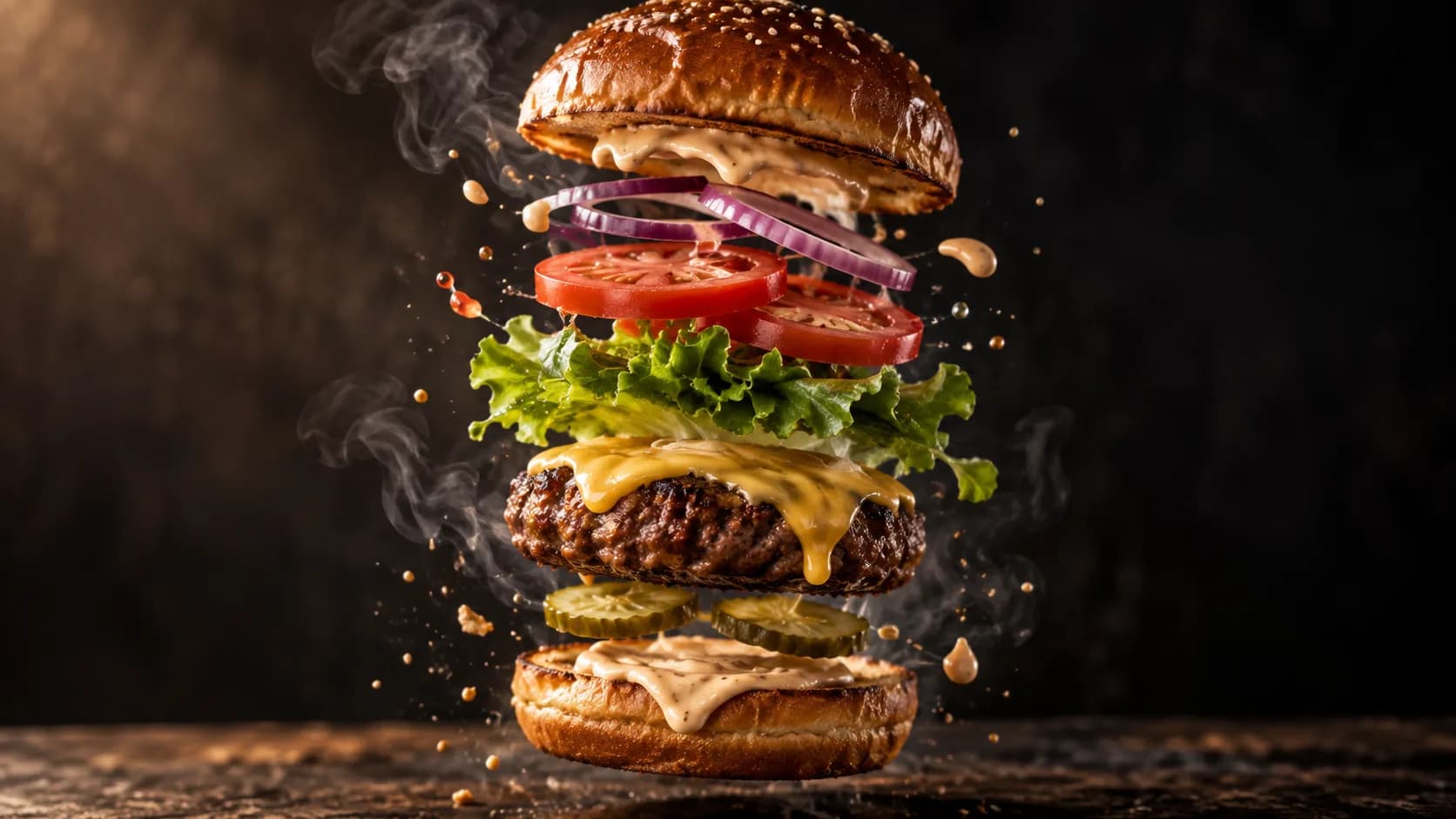
CGI ads for restaurants show the moments that make food irresistible, such as texture, flow and a sense of heat, with a level of control that's hard to reach on set. This piece covers where CGI helps restaurant and fast-food brands, when live action is the better call, how to plan a menu launch and three examples from Clytech.
The general production process and budget items are on our CGI ad film production page; here we focus on decisions specific to food and restaurant brands.
What makes food look appetising on screen?
Food looks appetising when a few visual cues let viewers feel the taste and the warmth through the screen. These belong less to the product itself than to its best moment:
- Texture: a crisp crust, the crumb of a bun, sear marks on the meat.
- Flow: running sauce, stretching cheese, pouring chocolate.
- A sense of heat: rising steam, sizzle, a glistening surface.
- Freshness: water droplets on greens, the bright colour of a sliced tomato.
- Motion: layers separating in the air, ingredients falling slowly, slow-motion pours.
The problem is that most of these moments don't last on set. Steam fades, cheese sets and greens wilt, and catching the same pour again means preparing the dish again. CGI takes on the moments that are hard to catch on set; it doesn't replace the work on set, it extends what's possible.
Fast-food and restaurant brands also have different priorities. For a fast-food brand, consistency matters: the same product has to look the same in every branch and on every screen. For a restaurant brand, atmosphere, the chef's touch and authenticity come first. That difference also sets the balance between CGI and live action.
Which moments can CGI control in food?
CGI makes each appetite cue controllable on its own: the density of the steam, the thickness of the sauce and the way light catches a surface can all be adjusted separately. The table sums up the most common approaches.
| Appetite cue | Why it's hard on set | CGI approach |
|---|---|---|
| Steam and heat | Fades quickly and gets lost in the light | Steam simulation with controlled density and direction |
| Flow | A pour happens once; repeating it means preparing the dish again | Liquid simulation at the speed and thickness you want |
| Texture | Flaws get magnified in macro | Macro 3D modelling, lighting and material work |
| Freshness | The product wilts under the lights | Controlled reflections, droplets and colour |
| Motion | Timing is hard to hit and repeat | Layers separating in the air, controlled falls |
We walk through how simulation, lighting and rendering work in a product film in How a CGI product film gets made.
When should you choose CGI, and when live action?
Live action is stronger when people, the place and the moment of sharing lead; CGI is stronger when flawless, repeatable product moments lead. For most restaurant brands, the right answer combines the two:
- Live action: the restaurant's atmosphere, people at the table, the chef's hands, the warmth of a shared meal.
- CGI or 3D: moments that are hard to repeat, consistency across menu visuals, launches before the product is ready, many variations, and impossible scenes like a giant burger appearing in the middle of a city.
- Hybrid: real footage is shot and digital scenes and impossible moments are added in CGI. In the Baydöner and Ohannes Burger films, digital scenes were blended with real footage.
Whichever route you take, the product on screen should be the product in the restaurant. Portion, ingredients and colour are built to match the real dish; for consumer trust and advertising rules alike, that isn't negotiable.
How do you plan a menu launch for social media?
CGI's biggest contribution to a menu launch is that one production feeds every channel. Once the product's 3D model or main scene is ready, these pieces can come from the same source:
- Teaser: short pieces that show just one detail of the product, like a pour or a texture.
- Launch film: a vertical hero film that brings together the product's most appetising moments.
- Social cuts: shorter versions from the hero film, each focused on one appetite cue.
- In-restaurant screens and digital menus: loops that work with the sound off.
- Delivery apps and the web: stills and short loops from the same model.
In a vertical feed, open a food video with its strongest appetite cue rather than the logo: a running sauce, rising steam or a burger splitting in two. For seasonal products or new sauces and ingredients, the same scene can be updated and reused.
Examples from Clytech
The three projects below present food and brand in different ways: CGI films blended with real footage for two restaurant brands, and a product animation built in 3D from start to finish. Clytech is a CGI, FOOH and AI advertising studio based in Istanbul and London, and all three were made in vertical 9:16.
The Baydöner CGI commercial gives the brand a cinematic look, with imagination blending into real footage. Bold digital scenes present the brand in a memorable way, and the vertical format keeps the film at home in social feeds.
PROJECT VIDEO
In the Ohannes Burger CGI film, the brand gets the cinematic treatment in a bold digital scene where imagination and reality overlap. Crafted visuals are blended with real footage, and the vertical piece is made to grab attention in social feeds. Together, the two films show that a restaurant brand can appear on social media as a cinematic scene, not just a product photo.
PROJECT VIDEO
For Şok Marketler's Karmen chocolate animation, the product was built in 3D from start to finish. The chocolate's texture, flow and appetising details were rebuilt in CGI, and careful lighting and material work gave it a realism that would be hard to capture in front of a camera. It isn't a restaurant project, but it shows what 3D can do for flowing products like the desserts and sauces on a menu. We cover packaged food and other fast-moving consumer goods separately in CGI for FMCG brands.
Frequently asked questions
Can CGI food be told apart from real food?
With the right lighting and material work, it stays convincing even in close-up; that's how the chocolate's realism was built in the Karmen animation. For scenes where warmth and authenticity matter, combining live action with CGI usually works best.
Can a food ad show the product differently from reality?
No. The product has to stay true to its portion, ingredients and colour. CGI makes that easier: the scene is built from photos and references of the real product and checked in the approval rounds.
Does the film have to be remade when the menu changes?
Often not. If the model and scene are ready, a new sauce, ingredient or presentation can usually be handled by updating the scene; we define the scope based on the brief.
Is there a shoot in the restaurant for CGI work?
In hybrid projects, yes: on most of our projects our own team shoots the real footage, and the digital scenes are built on top of it. For product animations, the product can be built from 3D models from start to finish; we'll recommend the right route for your brief.
What shapes the budget of a restaurant ad film?
Scene complexity more than film length: moments that need simulation (sauce, steam, liquids), whether a shoot is needed, and the number of versions and formats. We cover the details in What decides the price of a CGI ad film?
If you want to turn a menu item or your brand into a scene that makes people hungry, send us your brief and we'll come back within 24 hours with an approach. For films that focus only on the product, see our 3D product animation page.