
01ARTICLE
Published on
Jewellery CGI animation is a way of showing how a ring, a necklace or a diamond plays with light, with a level of control a camera struggles to reach. Jewellery brands use it in two ways: 3D product animation that shows the piece itself up close, and FOOH films that make the brand visible at city scale. Planned together, the same campaign gets talked about both in the window and on social media. You can see the full scope of the service on our 3D product animation page, and the city-scale illusion side on our FOOH ad production page.
This piece covers why jewellery brands turn to CGI and 3D, which format fits which goal, what a jewellery film must never get wrong, and what our work for the jewellery brand Reis Kuyumculuk teaches.
Why do jewellery brands use CGI and 3D?
Jewellery brands use CGI and 3D to keep the most valuable qualities of a small product (its sparkle, its craftsmanship, the colour of the stone) under control in every frame. Jewellery is one of the hardest products to advertise: it is small, its surface reflects everything around it, and viewers usually see it on a phone screen for a few seconds. The main reasons are these:
- Light and sparkle: the warmth of gold and the brilliance of a stone can be shown from the piece's most flattering angles, in exactly the tone the brand wants.
- Close-ups and scale: the inside of a ring or the detail of a solitaire can fill the screen, and the same piece can also appear as big as a building.
- Collection consistency: every piece in a collection is told with the same light and the same visual language, so the catalogue, the online store and social media all look alike.
- Reuse: once a piece has been prepared digitally, it can be used again for new edits, new seasons and different formats.
These strengths matter most when the product itself is being sold: at launch, around gifting dates and on product pages. If you want the wider picture of which product categories 3D suits best, our guide what is 3D product animation covers it, and jewellery is one of the categories that stands out there too.
Which format fits: 3D animation, FOOH or a billboard illusion?
The right format depends on what the campaign needs to say: is it about the piece itself, or about the brand's ambition and style? The table below compares the three formats jewellery brands use most often.
| Format | What it tells best | Where it runs | What to watch |
|---|---|---|---|
| 3D product animation | The craftsmanship, light and detail of the piece | Online store, in-store screens, launches, social media | The piece staying true to the real product |
| Giant jewellery in the city (FOOH) | The brand's ambition and scale | Social media, gifting and seasonal campaigns | A familiar place and an idea you can explain in one sentence |
| Billboard or storefront illusion | The link between brand and place, interest in the store | Social media, store openings, seasonal campaigns | The brand being readable in the opening seconds |
These formats are rarely alternatives to each other; more often they are parts of the same campaign. The 3D animation gets the product ready to sell, while FOOH and billboard illusions get people talking about the brand. A smaller jeweller can start with a single product film and, the following season, make the same piece the hero of a city-scale illusion. We break down what shapes the budget of a product film in what decides the price of a 3D product animation.
What should a jewellery film never get wrong?
The most important thing in a jewellery film is that the piece on screen is the same as the piece in the store. However striking the light, customers should recognise in the film the exact product they later see in the window. This checklist makes the brief easier to write:
- Accurate product information: metal colour, stone layout, proportions and surface finish (polished, matte, textured) should be shared from the start. Design files or clear photos from several angles speed everything up.
- The tone of the light: warm gold, or a cool white sparkle? The tone the brand uses in its windows and catalogue should carry through into the film.
- Limits on sparkle: the shine should be striking, but it should never show a stone in a different colour or size than it really is. With jewellery, trust matters as much as the image itself.
- A hero piece: decide early which piece in the collection leads. The idea of the film is built around it; a film that tries to show every piece at once leaves none of them in the viewer's mind.
- Channel and format: if vertical versions for social media and horizontal versions for in-store screens or the website are planned from the outset, there is no last-minute reframing.
The process itself stays simple: idea and sign-off, a shoot if one is needed, production, edit and delivery. At Clytech we get back to every brief within 24 hours, and when the people who sign off are named at the start, the schedule stays calm too.
How do 3D animation and FOOH work together in one campaign?
The strongest jewellery campaigns treat the close-up of the product and the brand's big moment in the city as two ends of the same story. The FOOH film grabs attention and gets the brand talked about; the 3D product film carries that attention on to the product and the sale. In practice, a flow like this works well:
- Opening: one strong image, such as a giant ring appearing in the city at an unexpected scale, or a building turning into a jewel box.
- Follow-up: a close-up 3D film of the same piece, with its light, stones and craftsmanship.
- Close: the store, the window or the product page, where the viewer can see the piece for real.
Gifting moments such as Valentine's Day, the new year and Mother's Day are natural fits for this flow. Because the release date is fixed from the start, planning can run backwards from it and each piece goes live in the right week. We look at ideas that put a brand's logo or product in the sky in FOOH and CGI in the sky.
Examples from Clytech
Clytech is a CGI, FOOH and AI advertising studio based in Istanbul and London. We have produced more than 150 projects for 85+ brands, and our work for Reis Kuyumculuk shows how the formats above come together for a single jewellery brand.
Reis Kuyumculuk: 3D animation
The Reis Kuyumculuk 3D animation focuses on the relationship between jewellery and light. Reflections and brilliance across gold and stone surfaces become a controlled presentation that shows the brand's pieces from their most flattering angles. The horizontal film is a good example of what a campaign piece about the product itself can look like.
PROJECT VIDEO
Reis Kuyumculuk: a nighttime jewellery spectacle
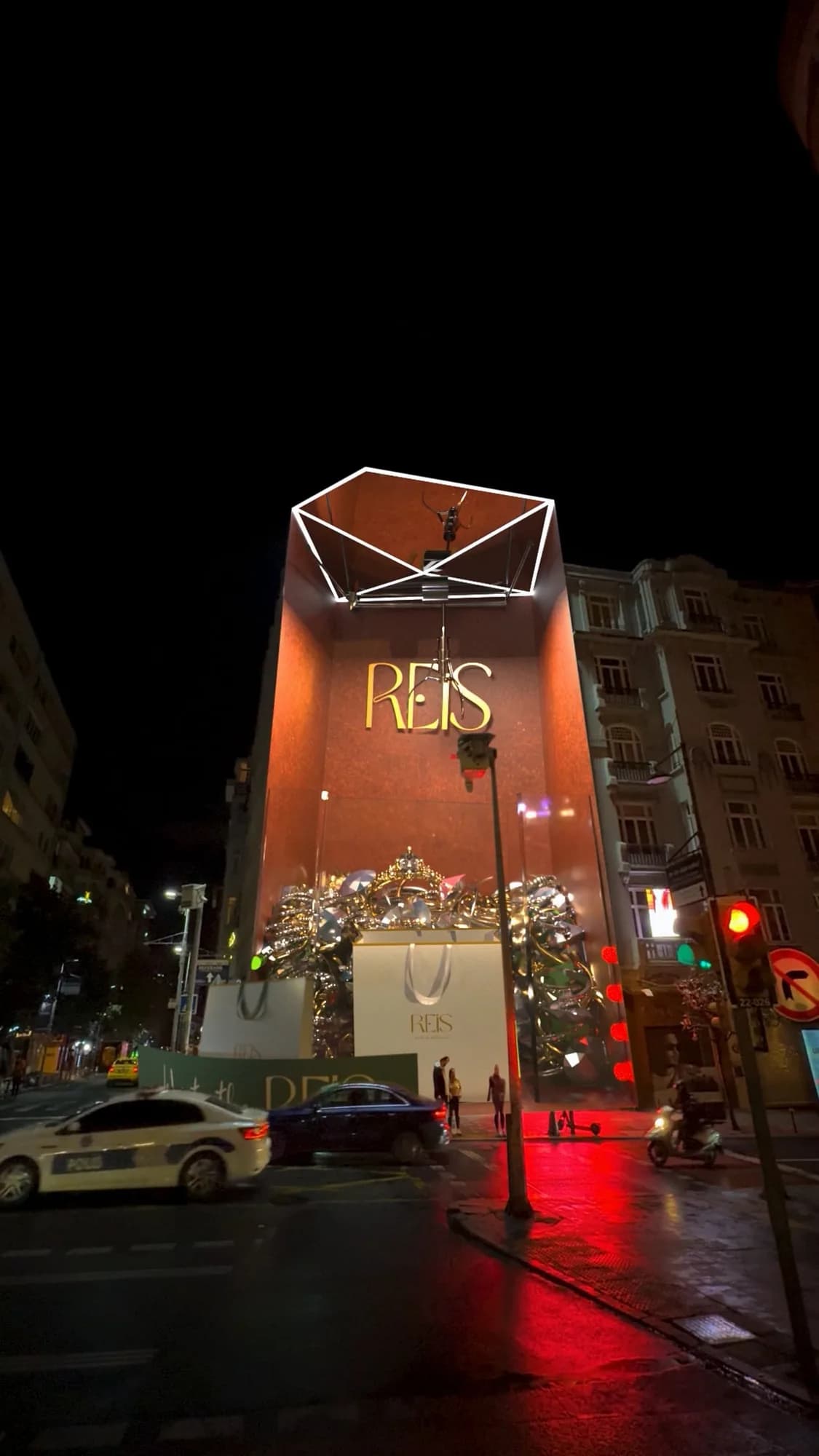
In the nighttime jewellery spectacle film, an entire building facade becomes a glowing jewel box after dark. A giant gold ring and sparkling diamonds emerge from the illuminated structure, turning the city into a surreal brand showcase. The vertical FOOH film shows the strength of an idea that pairs luxury jewellery with urban architecture.
PROJECT VIDEO
Reis Kuyumculuk: a flood of boxes
In the flood of boxes film, hundreds of the brand's signature boxes pour out of the boutique's storefront and into the street. This FOOH illusion channels luxury, abundance and brand power into a single visual idea, and it shows that sometimes the packaging, not the piece, can be the hero.
Reis Kuyumculuk: a billboard illusion
The billboard film brings the jewellery brand onto the urban stage with a giant billboard illusion, putting its shine on display at an unexpected scale. Edited vertically to drive organic engagement on social media, it is an example of a jewellery campaign that speaks the language of outdoor advertising.
Frequently asked questions
Should a jewellery ad use CGI or a photo shoot?
They answer different needs. For a quick catalogue image of a single piece, photography may be enough; for launch and social films where light, movement and scale matter, CGI and 3D give you far more control.
What do you need for a 3D jewellery animation?
Design files or clear photos of the piece from several angles, information on the metal and stones, and the channels the film will run on. The clearer the information, the more faithful the piece on screen will be to the real product.
How do jewellery brands use FOOH?
Usually by showing one recognisable element, such as a giant ring, a signature box or a building facade, at an unexpected scale in the city. Reis Kuyumculuk's nighttime spectacle and flood of boxes films are examples of this approach.
Can the same film run on social media and in the store?
Yes. If a vertical social version and a horizontal version for in-store screens or the website are planned from the start, the same film can run consistently across channels.
Let's talk about an idea for your collection
If you are looking for a film that lifts both the piece and the brand, for a new collection, a gifting campaign or a store opening, we can come back with a few ideas built around your hero piece. Share your brief with us, or take a look at our company presentation first.