
01ARTICLE
Published on
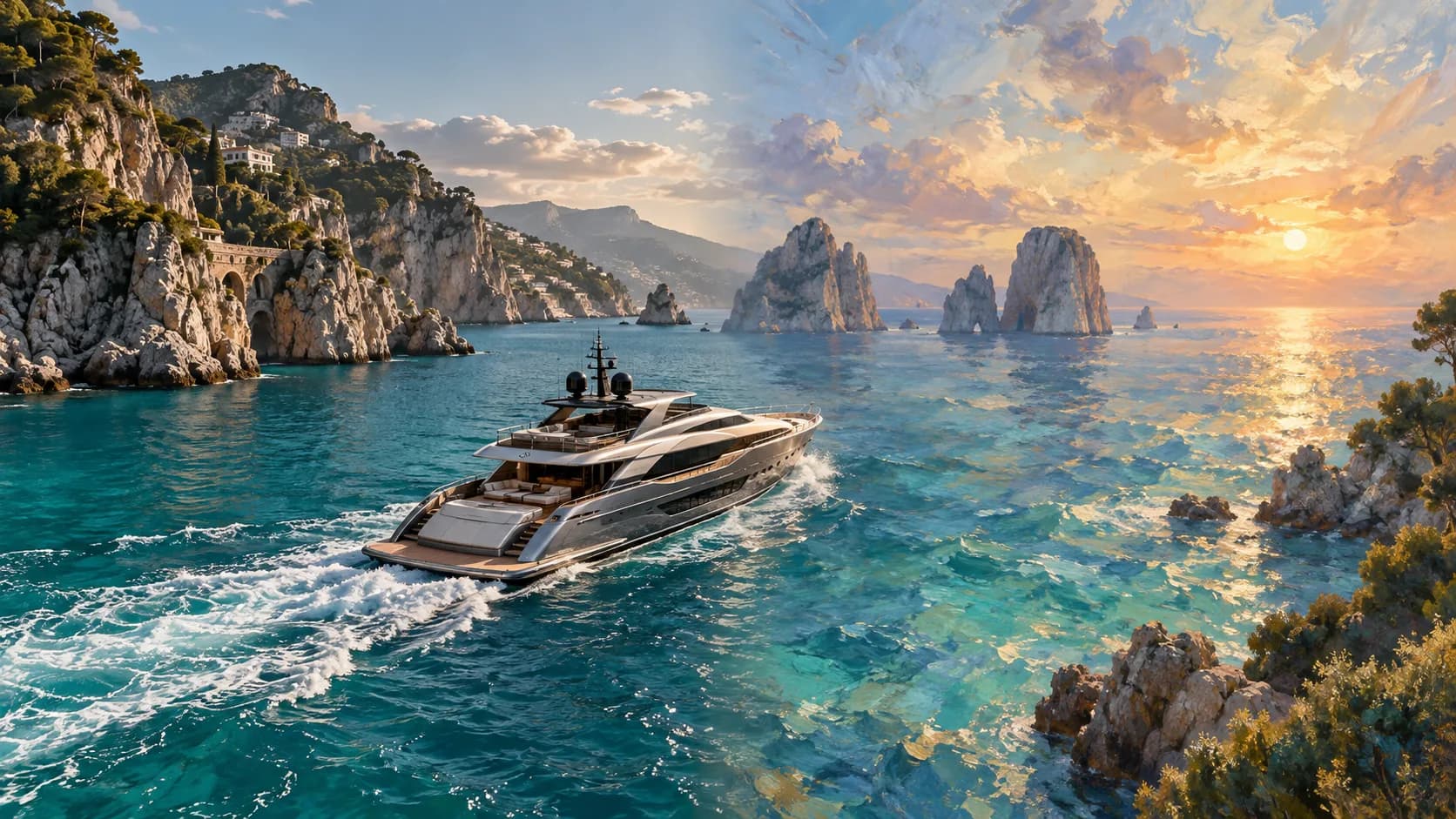
The difference between CGI and AI is clearest when the same theme is made both ways. For Suwen, we made two boat-themed films, one in CGI and one with AI: the CGI version takes the brand into an unexpected setting with a bold scene, while the AI version leads with elegance and the brand's aesthetic. The useful question isn't which one is better, but which brief each one suits.
Below we look at what each version emphasises, how CGI and generative AI differ in control, flexibility and revisions, and which brief calls for which method.
What do the two versions of the Suwen boat film show?
That one theme takes on a different character depending on the method. Both films are built on a boat idea for Suwen, and both were produced in vertical format for social media; where they part ways is emphasis.
- The CGI version: A bold boat concept carries Suwen's visual world out to sea. Blending imagination with cinematic visuals, the scene places the brand in an unexpected setting.
- The AI version: Elegance takes the helm. Built around a striking boat concept, the AI-generated scenes bring together imagination and cinematic visuals and carry the brand's aesthetic to the screen.
In short, the CGI version talks about boldness and staging, and the AI version about elegance and atmosphere. That split also lines up with each method's natural strengths: in CGI, every object and camera move is built deliberately, while in AI production the visual world generally takes shape by choosing from many attempts.
What is the difference between CGI and AI?
In CGI, the image is built from objects that artists model, light and animate; generative AI creates the image from written or visual prompts. That basic difference shapes everything from control to revisions:
| Criterion | CGI | AI |
|---|---|---|
| Control | Every object, material and camera move is set individually | Direction comes through prompts, references and selection; the result takes shape over iterations |
| Product accuracy | Label, logo and shape are modelled exactly | Label, logo and shape are checked in every frame and corrected where needed |
| Exploration and variations | Variations are possible once the scene is built; the initial build takes effort | Concepts and atmosphere can be explored quickly, with many variations tried |
| Revisions | Targeted: a material, a light or a camera angle can be changed on its own | Often means regenerating and reselecting; a small change can affect the whole frame |
| Consistency | The same model stays identical in every frame and format | Keeping a character or product consistent from shot to shot needs special care |
| Best-fit brief | Work where every product detail must be right, long-lived assets and multi-format delivery | Mood-led, seasonal or many-version content, and concept development |
Which brief suits CGI, and which suits AI?
If the brief's centre of gravity is the product, CGI leads; if it is atmosphere, AI does. Look for these signals when you decide:
Consider CGI if:
- The product, packaging or logo has to look exactly right in every frame.
- You will use the same images across formats, from TV to digital screens.
- You want revisions to change a single element of the scene.
- You plan to reuse the product model in future campaigns.
Consider AI if:
- The idea is built on a mood, an aesthetic or an atmosphere.
- You need many versions of the same concept for social media.
- Seasonal or news-driven content has to be ready quickly.
- You want to visualise and test a concept before a larger production.
On work where texture and light carry this much weight, control is worth more than flexibility. To make this call for a whole campaign rather than a single film, our piece on choosing between AI and CGI for your campaign takes the question to campaign level.
How do the two methods work together?
On hybrid projects we use CGI and AI together: the concept and visual world are explored quickly with AI, and the chosen direction is brought up to brand standards with CGI, editing and colour work. Depending on the brief, the film is made entirely with AI or blended with a real shoot.
This has two advantages. First, the brand sees more options early on; second, product accuracy is secured in the final stage through the control CGI offers.
Examples from Clytech
Suwen boat CGI film. A bold boat concept carries Suwen's visual world out to sea in this CGI film. Blending imagination with cinematic visuals, the scene places the brand in an unexpected setting; the film was produced in vertical format for social channels.
PROJECT VIDEO
Suwen boat AI film. The boat theme, this time made with AI tools: elegance takes the helm as a striking boat concept brings together imagination and cinematic visuals. The AI-generated scenes carry the brand's aesthetic in a vertical format designed for social media.
PROJECT VIDEO
Clytech is a CGI, FOOH and AI advertising studio based in Istanbul and London. We have delivered 150+ projects for 85+ brands in 15+ countries, and our work has passed 500 million views in total.
Frequently asked questions
What is the main difference between CGI and AI?
In CGI, the image is built from objects that artists model and control; AI generates the image from prompts and references. That is why CGI leads on control and accuracy, and AI on exploration and variations.
How do the two versions of the Suwen boat film differ?
Both are built on a boat theme and were produced in vertical format. The CGI version takes the brand into an unexpected setting with a bold scene; the AI version leads with elegance and the brand's aesthetic.
Is AI faster than CGI?
At the exploration stage, AI is usually quicker. Reaching final quality still takes selection, correction and checks, so we confirm the exact schedule once we have seen the brief.
Will our product look right in AI imagery?
Depending on the project, the product comes from your photos, our own shoot, a 3D model or AI. In every case, the final check is that the label, logo and shape are true to the real product.
Can one project use both methods?
Yes, and most do. AI is used to explore the concept and variations, CGI secures product accuracy, and a real shoot is added when the brief calls for it.
Let's pick the right method for your brief
CGI, AI or both together? The answer lies in the idea and the goal. Send us a short brief and we'll come back within 24 hours with the route we recommend and our reasoning. To see more of our work first, take a look at our company presentation.