
01ARTICLE
Published on
The short answer to the AI vs CGI advertising question is this: if the product has to look exactly right, CGI leads; if you need atmosphere and fast exploration, generative AI leads. In most campaigns the honest answer is that both are used together. Below is what actually decides it, where each approach is strong, and how both are used in real Clytech work. The AI side of our work sits on the AI ad film production page and the CGI side on the CGI ad film production page.
This article does not argue that one method beats the other. The two suit different briefs, and the decision usually comes down to the product itself and the assets you already have.
The short answer: which brief suits which?
The table below summarises the questions we ask in the first meeting.
| If your brief needs | Usually the right fit |
|---|---|
| Packaging, logo and texture to be exactly right | CGI |
| A giant-scale scene that bends physics | CGI |
| The atmosphere of a season or a collection | Generative AI |
| Character design and world building | Generative AI |
| Many variations and fast iteration | Generative AI |
| The same scene to stay unchanged for a long time | CGI |
| A real place and a real performer | Live action, with CGI on top |
Read the table as a starting point; the final call depends on how the product looks and which assets are already in hand. If you also want FOOH and 3D product animation in the same decision, the guide comparing all four formats lays out a wider table.
Where CGI is the stronger choice
The real strength of CGI is control. Every object, every light and every camera move is built by artists, so packaging, labels and surfaces can look exactly as the brand guidelines require. When a revision comes in, the scene does not have to be produced again from scratch; the relevant layer changes.
- Product accuracy: macro detail and difficult surfaces such as glass, liquid and metal stay under control.
- Impossible scale: a product at city scale, or a scene that could not be built physically, belongs to CGI.
- Longer life: the same 3D asset can be reused in later campaigns.
- Multiple formats: vertical and horizontal versions come from one scene.
If your real question is CGI versus a camera, CGI or live action covers that comparison in detail.
Where generative AI is the stronger choice
What generative AI brings is speed of exploration. The tone of a season, the expression of a character or the mood of a scene can be tried in several directions at once and chosen together with the brand. It does not replace the idea; it shortens the stretch between having an idea and seeing variations of it.
- Atmosphere and tone: the feel of a collection, a season, a light world.
- Character and world building: designing a brand character and settling its visual language.
- Variation: many versions of one idea adapted to different placements.
- Seasonal content: a faster production line when the calendar is tight.
We wrote about how AI production differs from the traditional route in a separate article, and about the workflow itself in the AI ad film process.
Hybrid: using both in one pipeline
In short: idea and approval, a shoot if needed, CGI production, edit and delivery. You sign off at every stage.
Examples from Clytech
Four real projects make the decision easier to see.
Roman — the mood of a season
In the hybrid campaign we produced for Roman's Winter 2026 season, the elegance of cold textures and futuristic layers come together in one narrative. Fashion-film aesthetics and AI-driven production work side by side to carry the mood of the season into the brand's signature style. When a brief asks for atmosphere rather than product accuracy, this direction is strong.
Tadelle — letting CGI carry the product
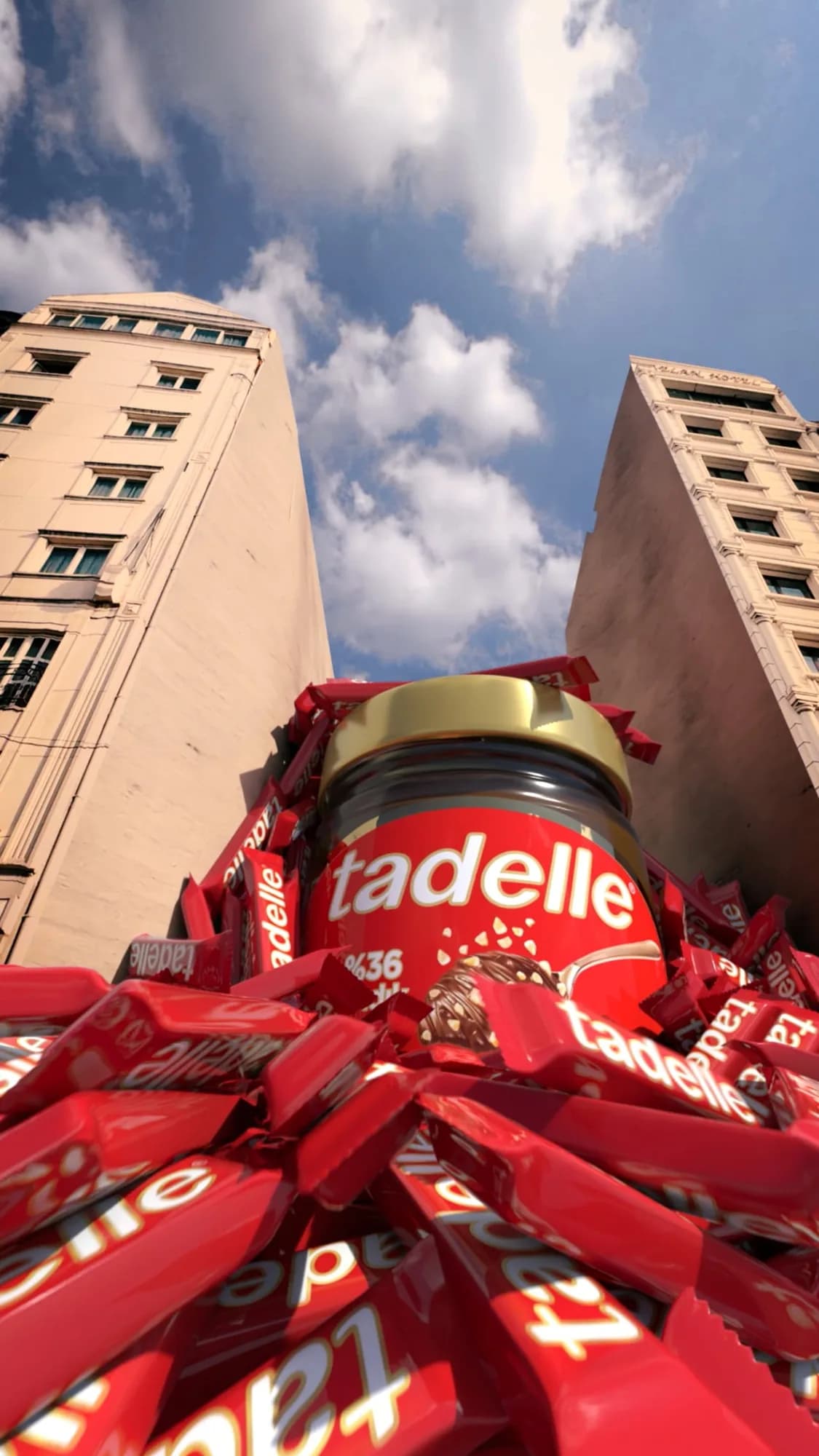
The Tadelle chocolate commercial presents the brand's iconic product through cinematic visuals, combining real footage with CGI produced in our studio. Made as production CGI, the film reached 29 million views, and together with the World Red Dress Day metro film the campaign passed 45 million in total. When the product itself is the lead, control wins the argument.
PROJECT VIDEO
Nutella — a shoot and CGI in the same frame
In the Nutella hybrid CGI transformation, live action and computer-generated imagery meet in the same frame and the iconic jar turns into a refreshing summer moment through one seamless narrative. The transitions were crafted so the viewer never notices where the footage ends and the CGI begins.
If you want to see one theme treated both ways, our comparison of Suwen's boat film in CGI and in AI is a good place to start, and AI advertising examples from Turkey collects more of the AI work.
Frequently asked questions
Is AI replacing CGI?
No. They do different jobs: CGI gives control and product accuracy, AI gives speed of exploration and variation. Clytech is a CGI, FOOH and AI advertising studio based in Istanbul and London, and runs both lines with the same team.
Can AI render my product exactly right?
When packaging, logo and label accuracy are critical, building the product in CGI is the safer route. AI is then used for the environment, the atmosphere and the variations around it.
What if I have no product photography or 3D model?
Depending on the project, the product can come from the brand's own photography, from a shoot of ours, from a 3D model or from AI. We agree which route fits in the first conversation.
Can one campaign use both?
Yes, and in hybrid work it is routine. What matters is that the brand knows and approves which method was used at which stage.
Let's make the call together
The useful question is not which method is better, but what your brief actually requires. Even a short note about the product, the placement and the timeline is enough to point the way: send us your brief and we will get back to you within 24 hours. If you would rather see work from both lines in one place, our studio deck is ready.