
01ARTICLE
Published on
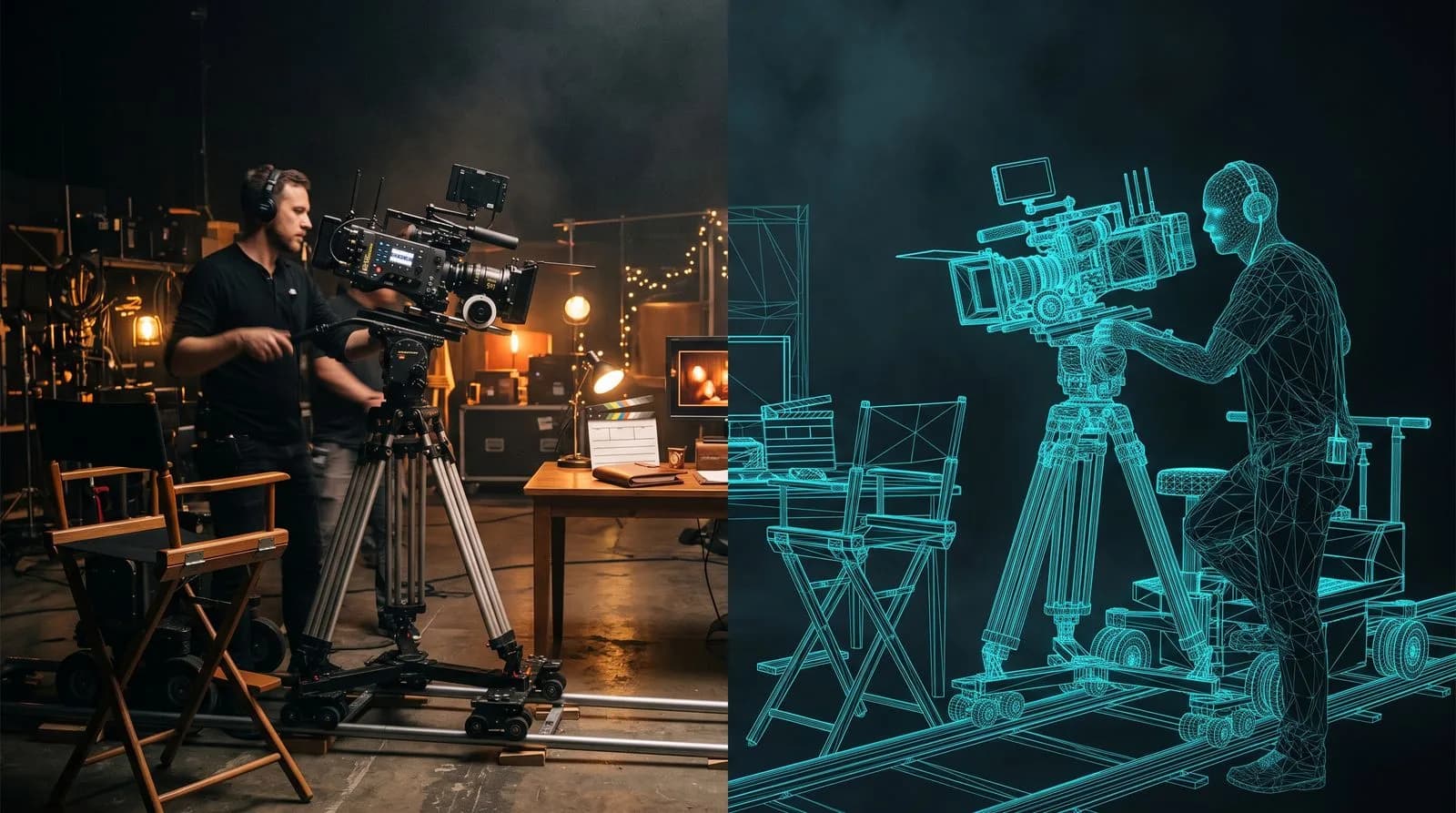
It may be surprising to read this from a CGI studio, but for some projects live action is the better choice. The classic question in every production meeting, "should we shoot it or build it?", is a practical decision, not an ideological one. Below we compare the two routes on cost drivers, speed, revisions and format flexibility; you can see our CGI work on the CGI commercial production page.
Where does live action win?
If you are telling a human story, a real face and real emotion are still unmatched; one look from an actor gives what the best render cannot. Live action is also strong for products whose texture drives appetite, for performance-led scenes and for documentary-style work.
Where does CGI win?
If you need to bend physics, move the camera inside the product or build a world that doesn't exist, a shoot isn't even an option. When the product must look flawless from every angle, CGI gives you control: light, reflections and framing can be adjusted as often as needed. 3D product animation exists for exactly this. We explain what CGI advertising is and how it is made, with examples, in what is CGI advertising.
Four factors compared
| Factor | Live action | CGI |
|---|---|---|
| Cost | The budget is spread across location, crew, cast, equipment and shoot days. | The budget goes mostly to modelling, animation, lighting and rendering work. |
| Speed | The schedule depends on weather, location and cast availability. | The schedule depends on scene complexity and approval rounds, going from concept approval to final render takes days rather than weeks on most projects |
| Revisions | "Let's make the product red" often means a reshoot. | The same change is a material update; the scene can be updated even while the campaign is live. |
| Formats | Getting vertical, horizontal and DOOH versions from one shoot is a framing battle. | The scene opens a new camera for every ratio: move in for vertical, pull out for widescreen. |
Why the cost myth is wrong
"CGI is expensive" and "CGI is cheap" are both half-truths. The project decides which is more economical: a scene with an actor in a single location often makes more sense as a shoot, while a scene that puts a giant product in the middle of a city makes more sense in CGI. We explain how the line items add up in what decides the price of a CGI ad film.
The answer is often both
A large share of our most-viewed work is hybrid, bringing live action and CGI into the same frame. Tadelle's chocolate film combined a real shoot with CGI; it reached about 29 million views, and together with the metro film the campaign passed 45M+. SUWEN's bus stop FOOH was also a CGI illusion built on real city footage, with 58M+ views. We explain the format in what is FOOH, and why does it go viral.
Three example scenarios
- Launching a new drink: if you want to show the product at giant scale on a city landmark, go CGI or FOOH; if you want to show the moment a consumer enjoys it, shoot it. In most launches, both are part of the same plan.
- E-commerce and catalogues: when you need dozens of colours and variants, flawless shots from every angle and fast updates, CGI and 3D product visuals are the more efficient route.
- An emotional TV commercial: if the story is told on the face of a family, an athlete or an employee, live action stays at the centre, and CGI comes in only for moments that can't be filmed.
A short checklist for the decision
- Is the hero of the scene a person or a product?
- Does the idea bend the rules of physics?
- Must the product look flawless from every angle?
- How many formats and versions do you need?
- Might you need changes while the campaign is live?
If your answer to the first question is "a person", live action wins; if you answer "yes" to the others, CGI does. If the answers are mixed, think hybrid.
Frequently asked questions
Can a CGI ad look as real as live action?
Where human performance is at the centre, live action is still stronger.
Is there any filming in CGI projects?
In most of them, yes. Most of our CGI commercials and FOOH projects are built on real footage shot by our own team, while some product animations are built from 3D models from start to finish.
How do you plan a hybrid project?
First, decide which parts of the idea will be real and which will be rendered. The shoot is then planned around the scenes that will get CGI, so camera moves, light and framing match from the start.
If you're not sure which route fits your project, send us your brief and we'll recommend one with our reasoning. If live action is the better choice, we'll tell you that too: get in touch.
PROJECT VIDEO
PROJECT VIDEO