
01ARTICLE
Published on
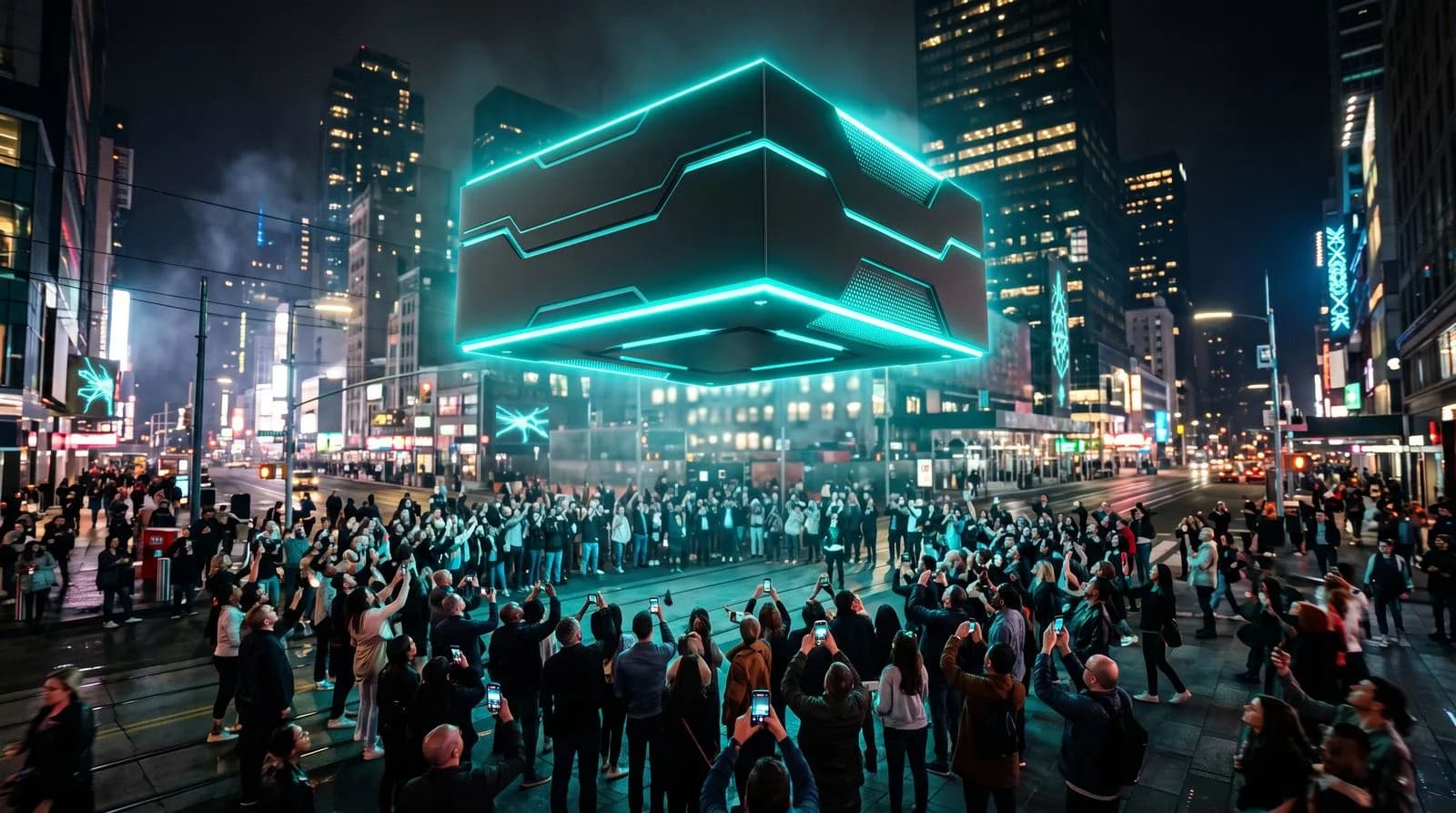
A giant product on top of a bus stop, a box floating over the Bosphorus, an oversized phone unfolding in a city square. None of it is really there, but the footage is from a real city. This is FOOH: fake out-of-home. It is a video format for social media in which CGI objects that bend the rules of physics are added to real location footage. You can see the FOOH work we have produced on our FOOH campaigns page; here we look at the format itself.
What exactly is FOOH?
FOOH is made by placing CGI-built 3D objects into footage shot at a real location. When camera movement, light, shadows and reflections match the real footage, the viewer pauses for a second and asks "is this real?". That pause is where the format gets all of its power.
The difference from traditional out-of-home is simple: no billboard is rented and nothing is physically installed in the city. The video is designed for social media from the first frame and lives there. We compare the two channels side by side, on audience, budget and measurement, in FOOH vs OOH: what's the difference. Production still starts with a real shoot, and on most of our projects our own team shoots it. Depending on the brief, some FOOH is produced with AI, on the desktop or on top of existing footage.
How is FOOH made?
In short: idea and approval, a shoot if needed, CGI production, edit and delivery. You sign off at every stage.
We cover the planning side step by step in how to plan a FOOH campaign.
Why does FOOH get shared so much?
Because everyone who watches asks the same question: "is this real?". That question turns into comments, and comments turn into shares. A traditional ad asks for attention; FOOH creates curiosity. People don't share the ad, they share the debate.
The second reason is the format itself. FOOH videos are short, work without sound and need no context, which makes them perfect to send to someone with "look at this". Seeing a familiar place at a broken scale also interrupts the scrolling reflex: the viewer stops, and the algorithm notices the stop.
How do brands use FOOH?
- Product launches: showing a new product at giant scale on a city landmark is one of the fastest ways to get talked about on launch day.
- Brand awareness: work that puts a pack, a colour or a shape into the fabric of a city makes a brand's visual identity memorable.
- Seasonal and special-day campaigns: reinterpreting an existing campaign idea as FOOH carries the same message in a far more shareable format.
- Event and collaboration announcements: for concerts, festivals or capsule collections, FOOH creates a buzz a press release can't.
Three things that separate good FOOH from bad
- Location accuracy: light, reflections and perspective must sit exactly on the real footage; the eye spots a mismatched shadow immediately.
- One idea: the best FOOH can be told in one sentence: "there's a giant product on the bus stop". A complicated story is harder to share.
- Brand dose: the product should be the hero of the scene, not its logo. Too much branding breaks the "is it real?" spell.
Examples from Clytech
Clytech is a CGI, FOOH and AI advertising studio based in Istanbul and London; we have worked with 85+ brands in more than 15 countries. Three FOOH projects stand out:
- SUWEN bus stop FOOH: an ordinary bus stop, a giant product on top and a one-sentence idea. It passed 58 million views.
- PUBG Mobile, the Republic's 100th anniversary: a FOOH campaign we brought to life in six regions of Turkey (İzmir, Ankara, Mardin, the Black Sea region, Antalya and Istanbul), with 30M+ views.
- Tadelle, World Red Dress Day metro film: about 16 million views; together with the chocolate film, the campaign passed 45M+ in total.
When is FOOH the right choice, and when not?
FOOH is a strong tool for launches, season openings and riding the news cycle. But not every brief is a FOOH brief: if the product story needs detail, 3D product animation may fit better, and if it needs acting and emotion, a classic commercial may be the right call. We compare the two routes in CGI or live action?
FOOH in Turkey
In Turkey, FOOH is no longer an experiment. In a country with locations from the Istanbul skyline to Cappadocia, the format has plenty to work with, and fashion, beauty, food and tech brands now use FOOH regularly in social campaigns. We have gathered ten campaigns from Turkey and abroad in FOOH advertising examples. Audiences know the format: they appreciate well-made work and spot poorly made work instantly. We list what to look for when choosing a studio in how to choose a CGI and FOOH studio in Turkey.
Frequently asked questions
Is FOOH the same as a 3D billboard?
No. A 3D (anamorphic) billboard plays on a physical screen and is watched on site; FOOH is a video produced on top of real location footage and watched on social media. We compare the two with a table and examples in FOOH vs 3D anamorphic billboards.
What drives the budget of a FOOH project?
The complexity of the idea, the number of locations and shots, the detail of the CGI element, and the number of versions and formats. We break down similar items in what decides the price of a CGI ad film.
Can FOOH be made with AI?
Yes. Depending on the project, some FOOH is produced with AI, on the desktop or on top of existing footage. We choose the method that fits the brief together with you.
If you have an idea you'd describe as "if we saw this in the city, everyone would talk about it", you probably have a FOOH brief. Get in touch and let's shape the idea, location and timeline together.
PROJECT VIDEO
PROJECT VIDEO