
01ARTICLE
Published on
FOOH and 3D billboards get mixed up constantly, because both seem to promise the same thing: an impossible scene in a real city. The difference fits in one sentence — a 3D (anamorphic) billboard plays on a physical screen and is watched on site, while FOOH is a video produced on real location footage and watched on social media. That distinction changes the budget, the schedule and the way success is measured; we cover how FOOH itself is made on our FOOH ad production page.
What is a 3D (anamorphic) billboard?
An anamorphic billboard is an animation designed for a cornered or curved LED screen so that, from one specific viewing angle, it creates an illusion of depth. The image is calculated around the geometry of that screen: a viewer standing in the right spot sees the object break out of the frame. So the job has two parts — the 3D animation, and the physical screen that will play it.
That second part defines the character of the project. Screen resolution, the angle of the curve, viewing distance and the booking calendar are all agreed with the media owner, and the animation is re-cut to suit that specific screen. Because there is a real installation and a media plan in the city, the process follows the rules of classic out-of-home advertising.
What is FOOH?
FOOH (fake out-of-home) is a social video built on real city footage, with giant products, objects or scenes added in CGI that are not really there. On most of our projects our own team films the location, and the CGI element is placed into the footage to match the camera move, light and shadows. The moment a viewer pauses and asks whether it really happened is the moment the piece works. For the longer definition, see what FOOH is and why it goes viral.
Where do they diverge? A comparison
| Item | 3D (anamorphic) billboard | FOOH |
|---|---|---|
| Where it is watched | On a physical LED screen, on site | On social media, on a phone |
| What gets produced | A 3D animation calculated for one screen's geometry | A CGI scene built on real location footage |
| Media side | Screen booking, broadcast calendar, technical specification | No screen booking; the budget goes into producing the idea, with paid social planned separately |
| Format | Tied to the screen's ratio, often a custom size | Vertical and horizontal cuts, usually vertical first |
| Location dependency | Limited to wherever the screen stands | Any location you can film; several cities are possible |
| Measurement | The media owner's reach estimates and content filmed on site | The platforms' own counters: views, shares, comments |
| Revisions | Up to the booking date; screen conditions are fixed | At edit and CGI stages; a product or packaging change is a material update |
Which one fits which brief?
The decision starts with where the campaign wants to meet its audience.
- If you want a specific square and the crowd standing in it, an anamorphic billboard is the right tool; the experience happens on site and the people there film it themselves.
- If you want more than one screen's audience, FOOH is more flexible: the same idea can be staged in different locations and is not bound by borders.
- If the campaign has to hit a date, FOOH does not wait for a media calendar; it goes live as soon as production is finished.
- If the brand wants to be visible both on the street and on social, the two are planned together: an anamorphic version for the screen and a FOOH version for the feed.
To see the planning step by step, how to plan a FOOH campaign walks through the flow from location to launch.
Examples from Clytech
Clytech is a CGI, FOOH and AI advertising studio based in Istanbul and London. The four projects below all use a billboard as their stage; all four were produced as FOOH and edited vertically to be watched on social.
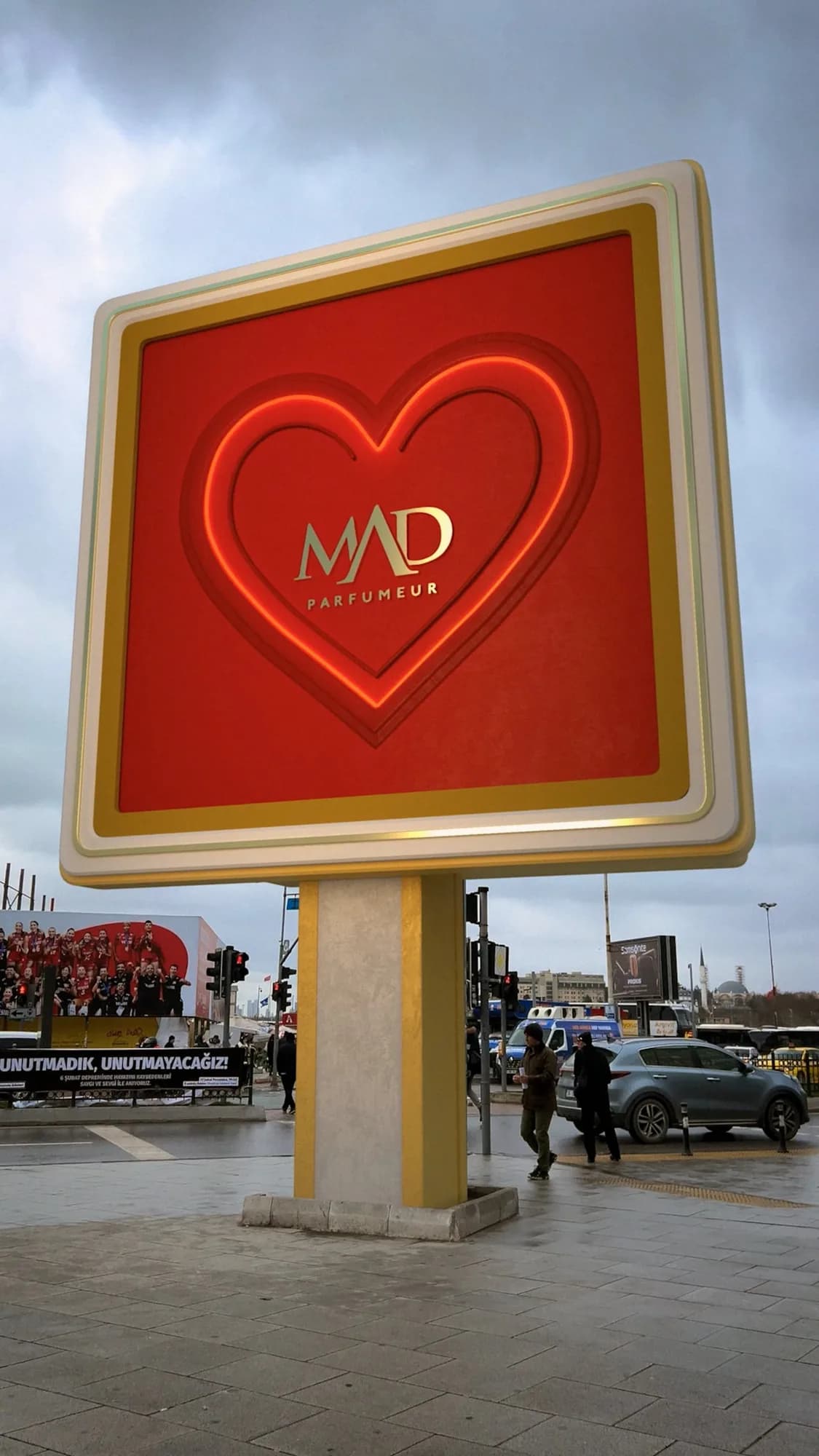
MAD Parfum — a giant bottle breaking out of a billboard. In this FOOH illusion, a giant perfume bottle smashes through a city billboard and the line between reality and imagination dissolves. This is precisely where conventional outdoor advertising turns into an immersive brand experience.
PROJECT VIDEO
Nutella — a 3D billboard illusion. In the CGI film we produced for Nutella, the brand becomes a larger-than-life spectacle through a bold 3D billboard illusion, and the giant-screen effect makes the product's iconic identity visible at city scale. We gathered the four different CGI films we made for Nutella in a separate piece.
PROJECT VIDEO
Estrid — an ordinary billboard, transformed. The film we made for Estrid turns an ordinary billboard into an unexpected illusion that puts the brand front and centre in the cityscape. Combining real footage with digital craft, the scene is built to make viewers wonder whether it actually happened.
A billboard is not the only stage: the same logic works on street furniture. The bus stop film we produced for Suwen passed 58 million views and turned a shelter into a brand showcase. For more examples from Turkey, see our piece on CGI advertising campaigns; and when the product itself is the hero, CGI ad film production takes over. If you are planning a FOOH or 3D billboard-style film in London, our guide to 3D billboard and FOOH production in London covers the city's locations and our examples there.
Frequently asked questions
Can a FOOH video be played on a real billboard?
A separate version of the same idea can be produced for a screen, but that is a different job: the anamorphic version is recalculated around the screen's geometry. A FOOH edit moved straight onto an LED screen will not deliver the intended depth effect.
Which one gets more views?
View counts come from the idea and the launch plan, not from the format, and nobody can honestly guarantee them. With FOOH the result is visible in the platforms' own counters; with an anamorphic billboard the conversation is about the media owner's reach estimates and the content filmed on site.
Is there a shoot for a 3D billboard too?
Not necessarily on the animation side; that work is usually built through 3D modelling and rendering. With FOOH, on most of our projects our own team films the location and the CGI element is placed into that footage.
What shapes the budget?
For an anamorphic billboard, screen booking and the broadcast calendar are added on top. In both cases the quote is shaped by scene complexity rather than length.
Can we use both in one campaign?
Yes, and it is often the most efficient route: the screen on the street builds awareness while the FOOH version multiplies the same idea on social. The one condition is that both versions are planned together from the start.
Even when the idea is identical, the production plan is not — which is why this call belongs at the brief stage. Write down where you want to be seen, share your brief, and within 24 hours we will tell you which route fits, with the reasoning. If you would rather see the work first, our studio presentation collects our billboard and street-furniture projects.