
01ARTICLE
Published on
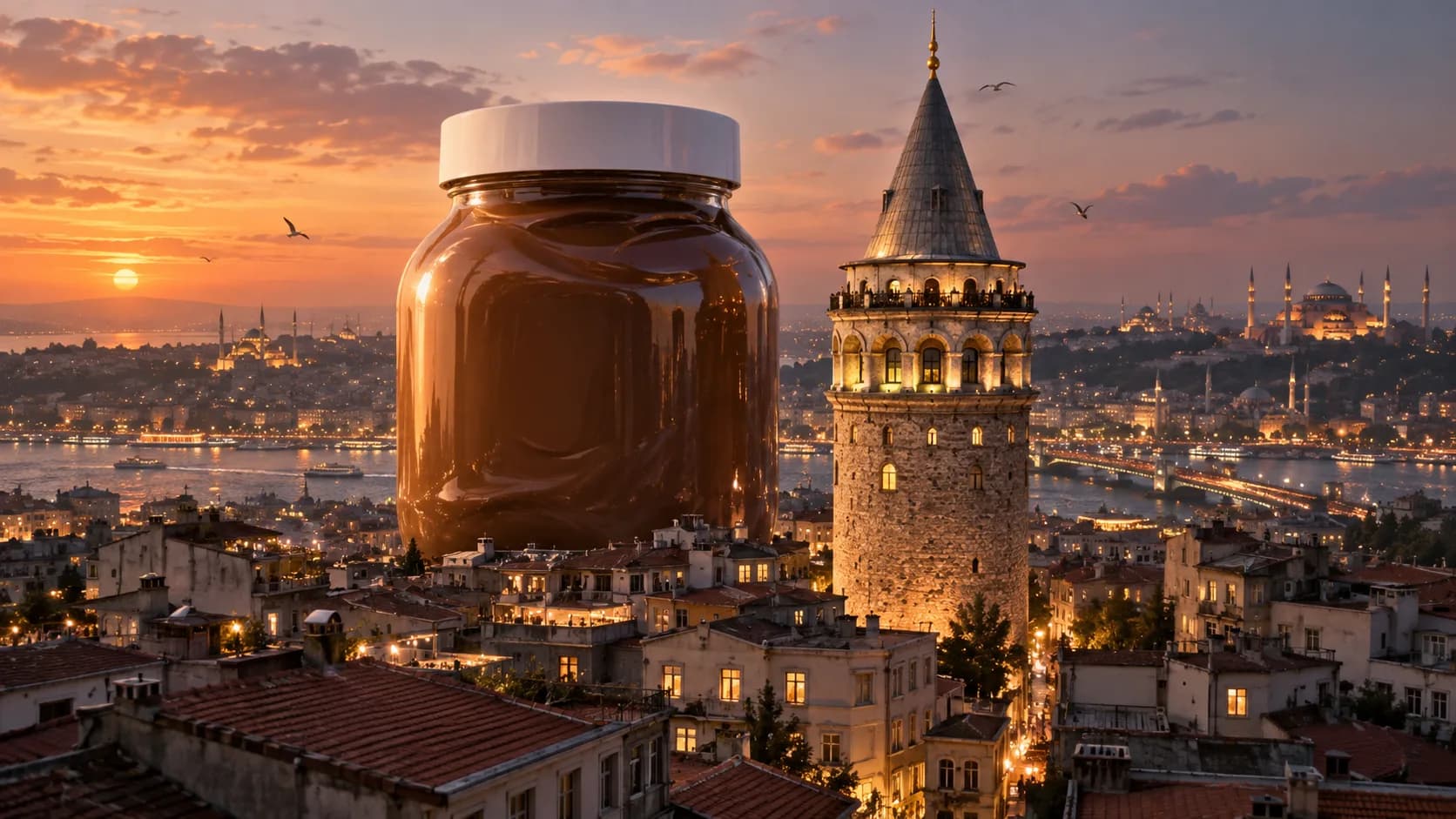
The four CGI films we made for Nutella show how one iconic product can be told through four different ad film approaches: a CGI product film for Nutella Go, a hybrid summer film that blends live action and CGI in the same frame, a 3D billboard illusion and a FOOH film staged on Galata Tower. The Nutella Go film alone passed 18 million views.
Below we set the four approaches side by side, look at which goal each one suits and what food and FMCG brands can take from them. Our CGI commercial production page covers the production process and delivery formats, and what is CGI advertising is a good primer if the topic is new to you.
How do the four approaches differ?
The four films place the same product in four different settings: its own cinematic world, a summer moment, a giant-screen illusion and a city landmark. The table sets them side by side.
| Film | Approach | Scene | Service type | Best suited to |
|---|---|---|---|---|
| Nutella Go CGI film | CGI product film | Digitally built scenes merge with real footage | CGI | Presenting the product in a bold, cinematic way |
| Nutella hybrid CGI transformation | Live action and CGI hybrid | The iconic jar turns into a refreshing summer moment | CGI, commercial film | Tying the product to a seasonal moment |
| Nutella 3D billboard CGI film | 3D billboard illusion | The brand becomes a city-scale spectacle through a giant-screen effect | CGI, FOOH | Visibility and attention at city scale |
| Nutella Galata Tower CGI film | FOOH on a landmark | A cinematic illusion built around Galata Tower | CGI, FOOH | Connecting the brand with a city and its landmark |
All four share a format: each was produced vertically for social feeds. Where they differ is the product's role in the scene. In the first two, the product sits at the heart of the story; in the last two, it is told through its relationship with the city.
When is a product film or a hybrid film the right choice?
When you want to tell the story of the product itself, its packaging and the moment you want it linked to. In the Nutella Go film, digitally built scenes merge with real footage to present the product in a bold, cinematic way. That approach gives a launch or a product reminder a strong backbone.
In the hybrid film, live action and CGI meet in the same frame, and Nutella's iconic jar turns into a refreshing summer moment in one seamless narrative. On work like this, the real craft lies in the transitions: the line between real footage and digital layers has to disappear, so the viewer never notices where the shoot ends and the CGI begins.
When you are deciding which shots belong on camera and which in CGI, our comparison CGI or live action is useful at the brief stage.
What do a 3D billboard illusion and a landmark FOOH do?
They take the brand beyond the product and into the scale of the city. In the 3D billboard film, Nutella becomes a larger-than-life spectacle through a giant-screen effect that makes the product's iconic identity visible at city scale. The piece pairs the attention-grabbing power of the 3D billboard format with the brand's warm, familiar world.
A distinction is worth making here. A real 3D (anamorphic) billboard plays on a physical screen and is watched on site. The Nutella piece is a CGI film built as a 3D billboard illusion, with CGI and FOOH as its service types. We explain the difference between the two formats in detail in FOOH vs 3D anamorphic billboards.
In the Galata Tower film, the stage is Istanbul's landmark itself. The CGI scene built around the tower creates a cinematic illusion that ties the brand to the city, combining real footage with digital craft. A landmark tells viewers where they are in the first frame and makes the unexpected product land harder.
Both approaches are strong for awareness and conversation. We gathered the questions to answer when planning one on our FOOH campaigns page.
What can FMCG brands learn from these four films?
The biggest lesson is that one iconic product doesn't have to live in one film. The same product can be told in different scenes for different goals. These points help when you plan your own:
- Pick the goal first: Do you want to present the product, tie it to a moment or get people talking in the city? The approach follows the goal.
- Treat the product's 3D model as an asset: A well-built product model can be reused across scenes, and a packaging change becomes a material update rather than a reshoot.
- Turn the season into an idea: A summer moment or a special day links the product to the calendar.
- Use the city as a stage: A landmark or a giant screen brings the product to street scale.
- Think vertical: All four films were produced vertically, and in a social feed the first second should belong to the product's strongest shot.
Realism matters too. With food, viewers are quick to notice texture and gloss; if the label, colour or shape isn't true to the real product, the scene loses trust however striking it is. That is why the final check on any product film is always the product itself.
Examples from Clytech
Nutella Go CGI film. Nutella Go meets the audience where imagination and reality cross paths. Digitally built scenes merge with real footage to present the product in a bold, cinematic way, and the vertical film passed 18 million views.
PROJECT VIDEO
Nutella, a cool transformation through hybrid CGI. In this hybrid production, live action and CGI share the frame as Nutella's iconic jar turns into a refreshing summer moment. The transitions between real footage and digital layers were crafted so the viewer never notices where the shoot ends and the CGI begins.
PROJECT VIDEO
Nutella 3D billboard CGI film. A bold 3D billboard illusion turns the brand into a larger-than-life spectacle, and the giant-screen effect makes the product's iconic identity visible at city scale.
Nutella Galata Tower CGI film. Istanbul's Galata Tower sets the stage for Nutella. Built around the city's best-known landmark, the digital scene creates a cinematic illusion that ties the brand to the streets of Istanbul; the film was produced vertically for social media.
Clytech is a CGI, FOOH and AI advertising studio based in Istanbul and London. We have delivered 150+ projects for 85+ brands in 15+ countries.
Frequently asked questions
Do the Nutella films use real footage?
In the Nutella Go film and the hybrid film, digital scenes are combined with real footage, and the Galata Tower film also blends real footage with digital craft. The 3D billboard film is built as a CGI illusion.
How many views did the Nutella Go film get?
Over 18 million. That figure belongs to the Nutella Go film.
What is the difference between a 3D billboard and FOOH?
A 3D (anamorphic) billboard plays on a physical screen and is watched on site; FOOH is a video produced on real location footage and watched on social media.
Which approach should an FMCG brand start with?
It depends on the goal. A product film suits a launch, a hybrid film suits a seasonal moment, and a FOOH or 3D billboard illusion suits city-scale conversation. Send a short brief and we'll recommend a route, with our reasoning.
Let's choose the right approach for your product
With the right scene, the same product can tell a new story every time. To talk about which approach fits your product and goal, send us your brief and we'll get back to you within 24 hours with an approach. To see more of our work, take a look at our company presentation.