
01ARTICLE
Published on
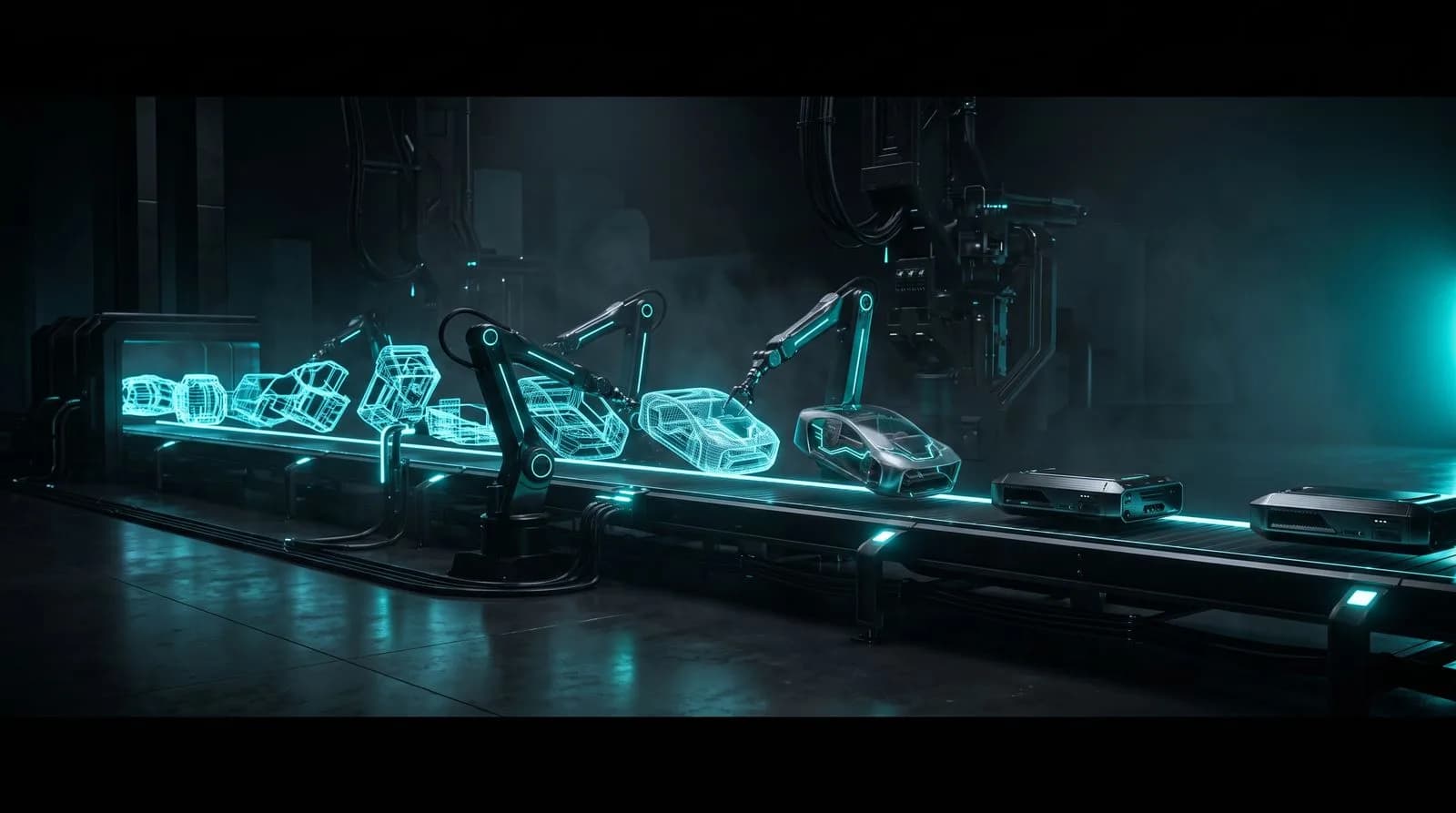
Look at the credits of ads that really work on social today and you'll rarely find one made with a single tool: there's a real shoot somewhere, CGI somewhere else and generative AI somewhere in the flow. That mix is called hybrid production: running each tool where it's strongest. You can see what we do with AI on our AI ad film production page.
What is hybrid production?
Hybrid production combines live action, CGI and AI generation in one workflow. None of them replaces the others: the camera brings human faces, texture and a sense of place; CGI perfects the product and bends the rules of physics; AI brings concept exploration, variation and speed.
Which part is made with which tool?
- Live action: human performance, emotion, close-ups of hands and faces, the atmosphere of a place.
- CGI: product accuracy, impossible scenes, plays on scale and FOOH-style placements.
- Generative AI: concept and moodboard exploration, background and environment variations, adaptations for formats and markets.
When this split is wrong, it shows immediately: work made entirely with AI can feel sterile, and work that tries to solve everything with a shoot doesn't fit the budget or the schedule.
AI's job: speed and exploration
Generative models speed up the concept stage. A moodboard used to take days of reference hunting; today dozens of directions can be explored in a single day. Showing the director's frame right after the brief shortens the approval process.
CGI's job: control and accuracy
AI imagines well but doesn't know your brand rules: the angle of the light, the proportions of the product, the colour of the pack. None of those errors can survive into the final image. The CGI layer builds the scene with physical accuracy, so the product keeps its own geometry and materials in every frame. That precision is also what keeps the "is it real?" feeling alive in FOOH: SUWEN's bus stop FOOH was a CGI illusion built on real city footage and passed 58M views.
Live action's job: people
Hands, faces, touch: the layer viewers connect with emotionally is still human. In hybrid AI campaigns like Roman's winter 2026 campaign, the brand's real product appears inside scenes built with AI.
Why does social reward this mix?
The first reason is credibility. Fully synthetic imagery can create distance; a real shoot says "this is a real place". When a CGI surprise lands on that real ground, the effect grows.
The second reason is the first few seconds. The power to stop the scroll often comes from an impossible element appearing inside a real scene; the brief clash between what viewers see and the physics they know is what stops them.
The third reason is volume. Platforms reward regular, frequent output. In a hybrid model, one shoot day becomes a content pool that CGI and AI can feed for a long time, which means more tests and more learning. Going viral can't be guaranteed, but its odds can be designed.
Five stages of a hybrid pipeline
- Brief: who is it for, which channel, and what should it make people do?
- Concept and moodboard: AI-assisted exploration; the approved moodboard becomes the production roadmap.
- Production: shoot, CGI and AI are produced to one plan so they fit together.
- Revisions: defined rounds; what changed and why stays traceable.
- Delivery: vertical, horizontal, DOOH and TV versions from the same scene.
Frequently asked questions
Is hybrid production cheaper?
Not always. We explain how the line items add up in what decides the price of a CGI ad film.
What can be made entirely with AI?
Concept visuals, some social content and character design can be produced entirely with AI. When product accuracy and brand rules are critical, combining AI with CGI and a real shoot is safer. We set out the decision criteria for your brief in AI or CGI? Choosing the right approach for your campaign.
How is AI production different from traditional production?
We compare process, cost and speed in AI production vs traditional production.
Not sure which mix tells your story best? Get in touch and we'll put together a recommendation with our reasoning.
PROJECT VIDEO
PROJECT VIDEO