
01ARTICLE
Published on
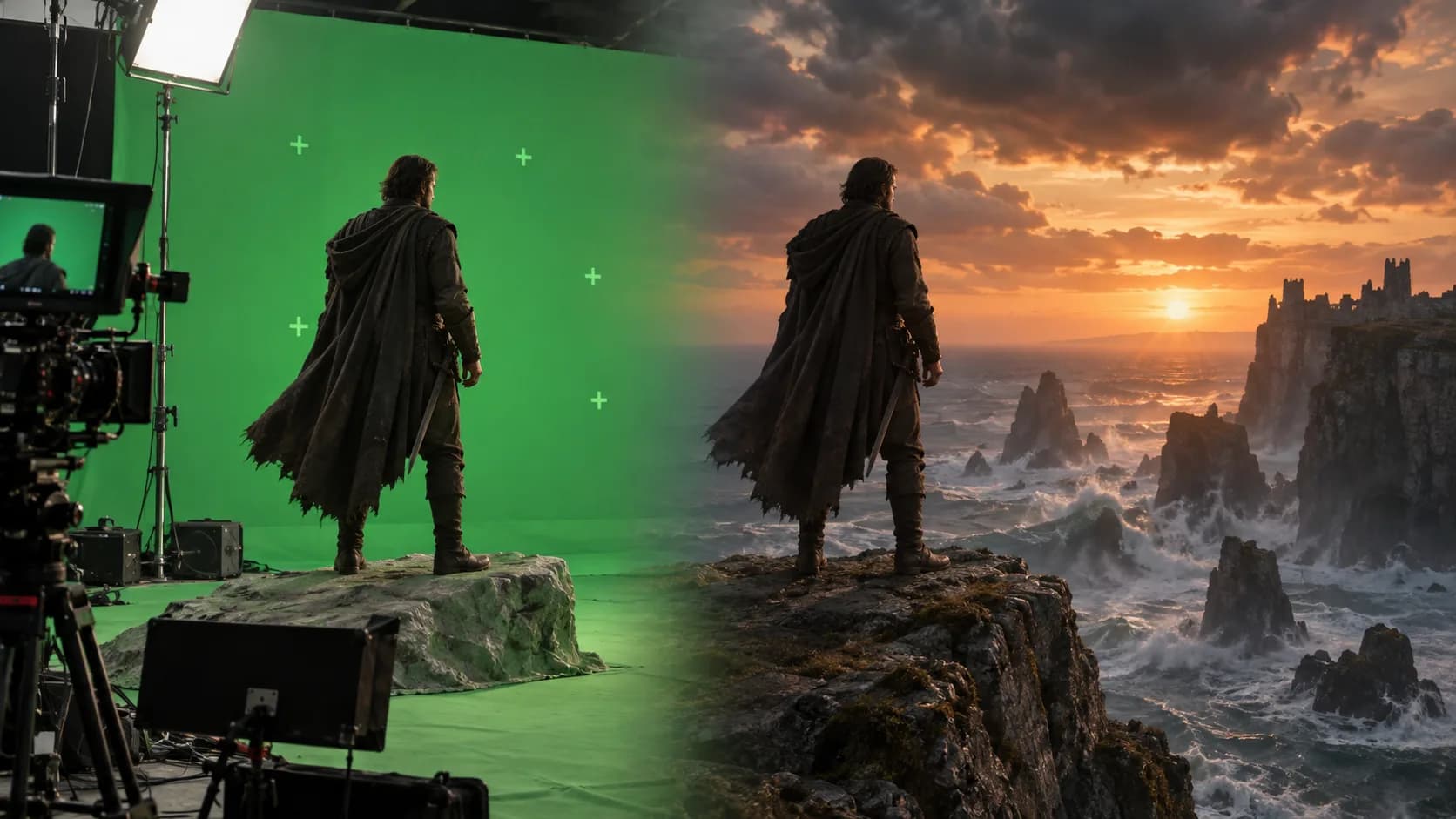
What is VFX? VFX (visual effects) means creating imagery that was never in front of the camera, or could not be filmed at all, and blending it with real footage after the shoot. CGI is one part of that toolkit: CGI is the computer-generated image itself, while VFX is the work of making that image sit convincingly inside live action.
This guide covers what the acronym stands for, how VFX differs from CGI and practical effects (SFX), the most common VFX types in commercials and how an effects shot gets made. If you are planning a film with effects, our CGI ad film production page explains formats and how quotes work.
What does VFX stand for, and what does it cover?
VFX is short for “visual effects”. It covers digital work done on footage after the shoot, not physical effects created on set in front of the camera. Adding a giant product to a real street, replacing the sky, painting out a cable in the frame or simulating chocolate pouring over a product are all VFX jobs.
Advertising also asks something different of VFX than cinema does. In feature films, VFX often means long sequences and digital characters; in a commercial, the job is usually to make a few seconds flawless and to adapt the same shot to many formats and placements.
VFX vs CGI vs SFX: what's the difference?
In short, SFX happens in front of the camera, VFX happens after it, and CGI is the material VFX uses most. The three terms are often mixed up, so here they are side by side:
| Term | Stands for | When it happens | Typical use in an ad |
|---|---|---|---|
| VFX | Visual effects | Mostly after the shoot, in post-production | A giant product added to a real street, a replaced sky, a removed sign |
| CGI | Computer-generated imagery | During 3D modelling, animation and rendering | A 3D product model, a digital character, a liquid or cloth simulation |
| SFX | Special effects (practical effects) | During the shoot, in front of the camera | Artificial snow, a smoke machine, a wind fan, a real water splash |
In practice the lines blur. Note that “SFX” is also used for sound effects; here it means physical effects on set. Our guide What is CGI advertising? covers CGI itself in more depth.
Which types of VFX are used in advertising?
In commercials, VFX usually does one or more of these five jobs:
- Set extension: A real location is enlarged or altered digitally. Adding floors to a building, transforming a shopfront or moving a scene to another city all fall under this.
- Clean-up: Unwanted elements are removed from the frame: cables, rigs, off-brand signage, crew caught in a reflection. Viewers never see it, yet almost every commercial needs it.
- Simulation: Physics-driven motion such as liquid, smoke, cloth, hair or particles is calculated by computer. Chocolate flowing over a product or confetti swirling in the air is usually a simulation.
- CGI elements: A product, object or character is modelled in 3D and added to the scene. The giant products that appear in city centres in FOOH campaigns are the most visible example.
How is VFX made for a commercial?
From idea to delivery, a VFX shot typically moves through these steps:
In short: idea and approval, a shoot if needed, CGI production, edit and delivery. You sign off at every stage.
When should you choose VFX?
VFX is the right call when an idea cannot be captured by the camera alone, or when filming it for real makes little sense:
- The scene is physically impossible: a coat wrapped around a tower, a giant shoe carried across a city.
- It is possible but risky or impractical: fire, flooding, crowds, delicate product movements.
- You need many versions of the same shot: different packaging, colours or languages. In CGI, a packaging change is a material update, not a reshoot.
- Every product detail must be perfect: labels, logos and surface texture can be controlled precisely in 3D.
Practical effects still win when an actor needs to react to something real, or when close-up sensations like touch and wetness carry the shot. Most strong commercials use both: real water on set, digital droplets in post.
Examples from Clytech
Clytech is a CGI, FOOH and AI advertising studio based in Istanbul and London. These three projects show the different jobs VFX can do in an ad.
Extending a real installation: Built to amplify J.Lindeberg's OOH activation in Stockholm, our giant shoe at NK Mall CGI film centres on the oversized version of the brand's new shoe installed at the NK department store. In the film, drones carry the shoe across the city before it arrives. Merging fashion with urban spectacle, the piece gathered over 200,000 views across Instagram, TikTok, Twitter and LinkedIn.
PROJECT VIDEO
The brand's iconic jar turns into a refreshing summer moment, and the transitions between real footage and digital layers were crafted so viewers never notice where the shoot ends and the CGI begins.
PROJECT VIDEO
A digital object on a real landmark: The Galata Tower coat installation film dresses Istanbul's landmark in a giant coat. Set against the city's real skyline, the digital installation brings fashion and architecture into one frame; the film was produced in vertical format for social media. Here, the VFX job is to make an object that was never there feel right in scale, light and motion. Our guide to fashion CGI campaigns shows how ideas like this work for a collection launch.
Frequently asked questions
What does VFX mean?
VFX stands for visual effects. It refers to imagery created digitally after the shoot and blended with real footage, covering anything the camera did not or could not capture.
Can VFX be planned after the shoot?
Let's work out where VFX can do the most for your ad. Send us a short brief and we'll reply within 24 hours with an approach. Everything we do is on our services page.