
01ARTICLE
Published on
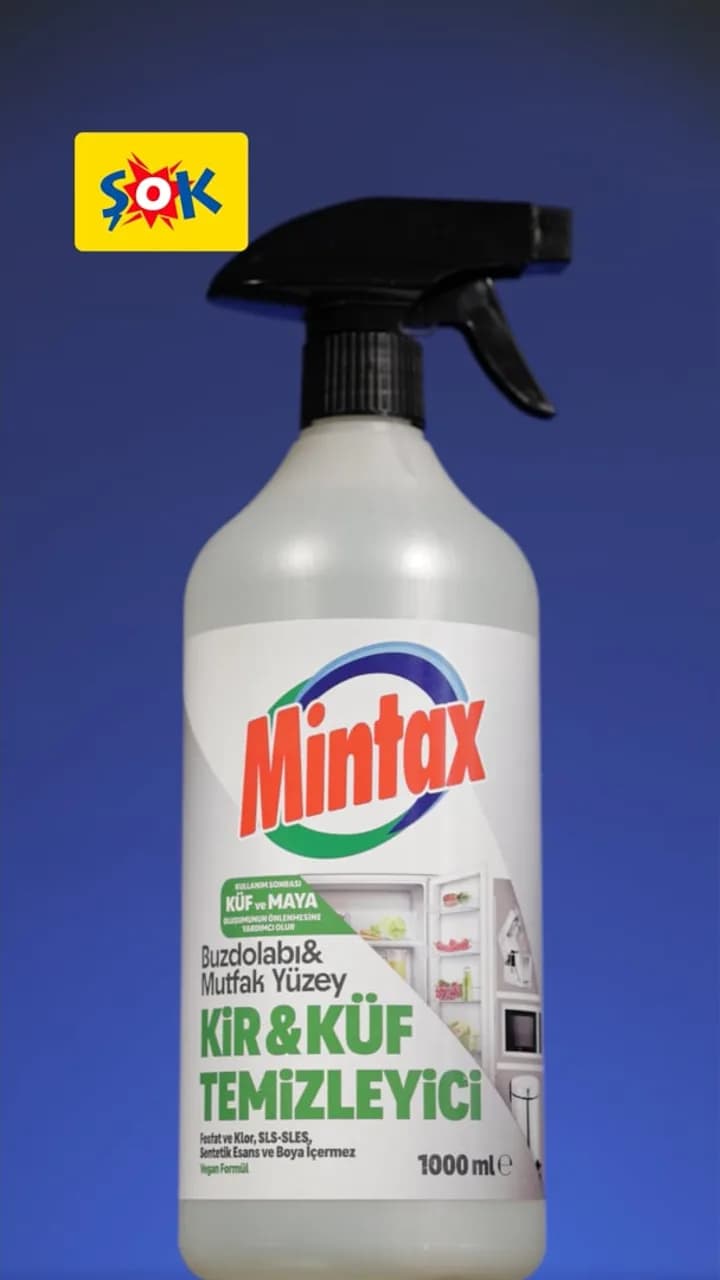
Cleaning product video production means telling the moment of use and the packaging of a mould cleaner, a detergent or a shampoo in a short, clear film: on a retail screen it shows the product and the offer, in e-commerce the packaging detail, on social media the moment of use. In the cleaning and personal care category, two things matter more than in other product films: the packaging and label have to look exactly right, and the same product usually has to be told through several use scenarios. This guide covers the decisions specific to this category, with real examples from our CGI ad film production work and the product films we produced for the retailer ŞOK.
Why is a cleaning or personal care product film built differently?
Because these products are remembered through a moment: the surface with the stain, the steamy bathroom, the morning the washing machine door opens. Viewers recognise the home the product enters and that moment, not the product itself. So the film is built around a single scene: the product, the surface and the gesture of use. Every statement about what the product does is tied to the brand's approved copy; the film does not try to prove that claim, it tries to make the product and the moment of use memorable. The general approach to product films, including length and framing per channel, is in our product video production guide; here we cover only what is specific to this category. Beauty products such as fragrance, serums and make-up are covered separately in beauty CGI advertising.
Use scenarios: bathroom, kitchen, laundry and personal care
The scenario is the place the product enters in the home, and every place is a separate film idea. In cleaning and personal care, four families of scenarios stand out.
- Bathroom: Tile grout, the shower screen and the sink, in a humid, steamy setting. For mould and grime cleaners this is the most familiar scene of all.
- Kitchen: Around the hob, the worktop, inside the fridge and under the sink; scenarios in which the same product meets different surfaces.
- Laundry: The machine door, the detergent drawer and washing on the line; a symbolic telling of cleanliness and freshness.
- Personal care: The shower, the mirror and the movement of hair; for products such as shampoo and care spray, the product is shown with its packaging and the gesture of use.
Producing several scenarios for one product is stronger than stretching one film, because each scenario speaks to a different viewer and a different channel. On the Mintax mould and grime cleaner work we produced for ŞOK, a fridge scenario and an under-sink scenario were made as separate pieces alongside the premium film: one product, three separate moments.
Why packaging and label accuracy is critical in this category
The cleaning aisle is crowded and products often sit in similar bottles; what viewers recognise is the colour of the cap, the shape of the bottle and the layout of the label. That is why the packaging looking exactly right comes before the beauty of the scene. Once the product is built correctly in CGI, a packaging change is an update, not a reshoot; a new size, a promotional label or a new fragrance variant is derived from the same film. The table sums up the decisions that come up most often in this category.
| Decision | Why it matters | How it is handled |
|---|---|---|
| Label and logo | The one element that makes the product recognisable on the shelf | Built exactly from the brand's packaging files; the label is the final check |
| Liquid, gel, spray or powder | The product's form sets the gesture of use | One flow, spray or pour moment is shown in a single movement, according to the product type |
| Surface and room | Viewers recognise the moment through the room | One surface and one movement are chosen per scenario |
| Offer information | Retail screens need space for the price or the promotion | The offer layer is kept separate and only that layer is updated when the period changes |
| Product variants | Fragrance and size variants under one brand | A version per variant is derived from the one film |
Which film for which channel?
One product needs as many cuts as it has channels, but they all come from one production. On retail screens the film plays in a short loop, has to work without sound and must show the product and the offer in the first second; we covered this approach for retailers' own screens in video content for retail media networks. In e-commerce, packaging detail and the moment of use are shown together. On social media the film is built vertically and opens on the moment of use. For a personal care brand that wants to be talked about on social media, a FOOH film in which a giant product enters the city is a separate option; Bioderma's giant serums rising from the Bosphorus are the example.
Examples from Clytech
Clytech is a CGI, FOOH and AI advertising studio based in Istanbul and London. The product films below were produced for ŞOK as part of ŞOK Media Network; on this work, our client is ŞOK. The last example is a FOOH film produced for a personal care brand.
Mintax mould and grime cleaner, premium film: A vertical product film produced in collaboration with ŞOK Market, presenting the cleaner in a premium tone. For the same product, separate moments of use such as the fridge scenario were produced as separate pieces; it is our clearest example of the one product, several scenarios approach. Project page.
PROJECT VIDEO
DP shampoo and care spray: A vertical product film produced for DP as part of ŞOK Media Network, presenting two personal care products in one film. The shampoo and the care spray are introduced together, showing how a product pair under one brand is tied into a single story. Project page.
Bingo Jet Jel: A vertical product film produced for Bingo as part of ŞOK Media Network, presenting the product and its packaging in a short, clear cut and showing how products under one brand are presented in a single visual language. Project page.
Bioderma, giant serums over the Bosphorus: Giant bottles of Bioderma's signature serums rise from the waters of the Bosphorus as passers-by stop to take in the surreal view. The FOOH campaign pairs skincare innovation with Istanbul's iconic scenery and was designed to spark curiosity and spread across social media. Project page.
PROJECT VIDEO
Frequently asked questions
Can a cleaning product video show what the product does?
Only within the brand's approved claim and in a symbolic way. The film is not an experiment proving the stain is gone; it is a scene that makes the product and the moment of use memorable, and neither the copy nor the visuals go beyond the approved product claim.
Can the same film be used for different sizes and fragrances?
Yes. Once the product is built correctly in CGI, a new size, a fragrance variant or a promotional label is derived from the same film; it is an update, not a reshoot.
Is there a shoot for a product film?
It depends on the project. On most of our work the base is real footage shot by our own team and the product is built on top of it in CGI; some product films are built from a 3D model from start to finish. We recommend the right route for your brief.
How short should the film be for a retail screen?
It is set by the screen's loop; rather than give a number, here is the rule: the product and the offer must be visible in the first seconds, and the film must make sense with the sound off. A longer version for social media is derived from the same production.
What should I send for a quote?
Packaging files or photos of the product, the approved product claim, the list of channels (retail screen, e-commerce, social media), the scenarios you want and the timeline. A short brief is enough; we reply within 24 hours with an approach.
Let's work out which scenarios and channels will do the job for your cleaning or personal care product. Send a short brief and we'll reply within 24 hours: get in touch. For an overview of all our work, see our company deck.