
01ARTICLE
Published on
CGI advertising for beauty and cosmetics brands makes the product the hero of the scene: the glass of a perfume bottle, the flow of a serum, the texture of a cream and the way light plays across a surface are shown with a precision a camera struggles to deliver on its own. Beauty brands use CGI most in launch films, vertical social edits and FOOH illusions set in real cities. This guide covers which approach suits which product, where to stop when showing what a product does, and the work Clytech has made for beauty brands.
The short definition: CGI (computer-generated imagery) is imagery created on a computer. In advertising, the product or part of the scene is built this way and, on most projects, combined with real footage. We've set out the scope and the items that shape the budget on our CGI ad film production page, and if you want the basics first, start with what CGI advertising is.
Why does CGI work so well for cosmetics?
Because so much of a beauty purchase rests on how the product looks, and CGI gives you control over exactly that. Light passing through a perfume bottle, the clarity of a serum drop or the shade of a lipstick won't look identical on every take on set. In CGI, those details are locked to the brand guidelines and stay consistent across every version.
The second reason is scale. Cosmetics are small and easily lost on a shelf or in a shop window. CGI turns that into an advantage by making the product a giant object in the middle of a city. When people see a bottle they recognise at an impossible size, they stop and look.
The third is continuity. Beauty brands release new shades, new packaging and seasonal editions all the time. In CGI, a product colour or packaging change is a material update rather than a reshoot, so the same film can be adapted for the new line.
What does CGI bring out in each beauty category?
Every product group has something a camera finds hard. The table below sums up what CGI makes visible in each one and the formats it usually suits.
| Product group | What CGI brings out | Common formats |
|---|---|---|
| Fragrance | The glass of the bottle, the metal of the cap, light refracting through it, the bottle's silhouette | Launch film, billboard illusion, giant-product FOOH |
| Serums and skincare | The clarity of a drop, the flow of the liquid, a symbolic picture of what's inside | Product film, vertical social edit |
| Make-up | Colour and pigment, the shade range, texture in close-up | Shade launch, short loops for product pages |
| Hair and body care | Foam, cream texture, packaging detail | In-store screen versions, social |
| Beauty retailers | Brand identity, store openings, campaign language | City-set FOOH, launch edits |
Treat the table as a starting point. A product film and a FOOH piece can be planned together for the same fragrance; the product's silhouette and the campaign goal decide which story goes in which format. For hair and body care products shown in everyday moments of use, such as shampoo and shower gel, see our guide to cleaning and personal care product videos.
Which formats do beauty brands use CGI for?
Four uses come up most often:
- Product films and 3D product animation: short films that present the product in a neutral or stylised setting, with its texture and light. One production yields versions for product pages, in-store screens and social. Our 3D product animation page has the details.
- FOOH: giant bottles placed into real city footage, products breaking out of billboards. It is designed to make people ask “is this real?” on social, and our FOOH ad production page walks through the formats.
- Launches and store openings: announcing a new product, range or store. Ideas that carry the brand's identity into the city are strongest here.
- Seasonal and holiday content: the same product scene re-dressed for the holidays, New Year or Valentine's Day.
If you're weighing up FOOH for a launch, five FOOH formats for product launches is a good next read.
How far should you go when showing product benefits?
In CGI, a product's benefit should be shown symbolically, and the image should never promise something the product doesn't do. The place where CGI is most powerful in beauty is also the place that needs the most care. Showing a serum's ingredients as glowing particles, or a cream's texture in extreme close-up, strengthens the message. Letting the visuals go beyond the brand's approved product claim erodes trust.
That's why we agree three rules at the start of every beauty project:
- Claims come from the brand. Every line and every piece of on-screen text is taken from the brand's approved wording; the visuals dress that line, they don't stretch it.
- Symbols and results stay separate. Particles, light trails and flows are visual metaphors for what's inside. Result imagery, such as before-and-after shots of skin or hair, shouldn't be built in CGI.
- Fidelity to the real product is the final check. Bottle shape, label, logo and shade are approved against the actual product.
Examples from Clytech
Clytech is a CGI, FOOH and AI advertising studio based in Istanbul and London. Four of the projects we've made for beauty and skincare brands show how different goals call for different ideas.
Bioderma: giant serums rising from the Bosphorus
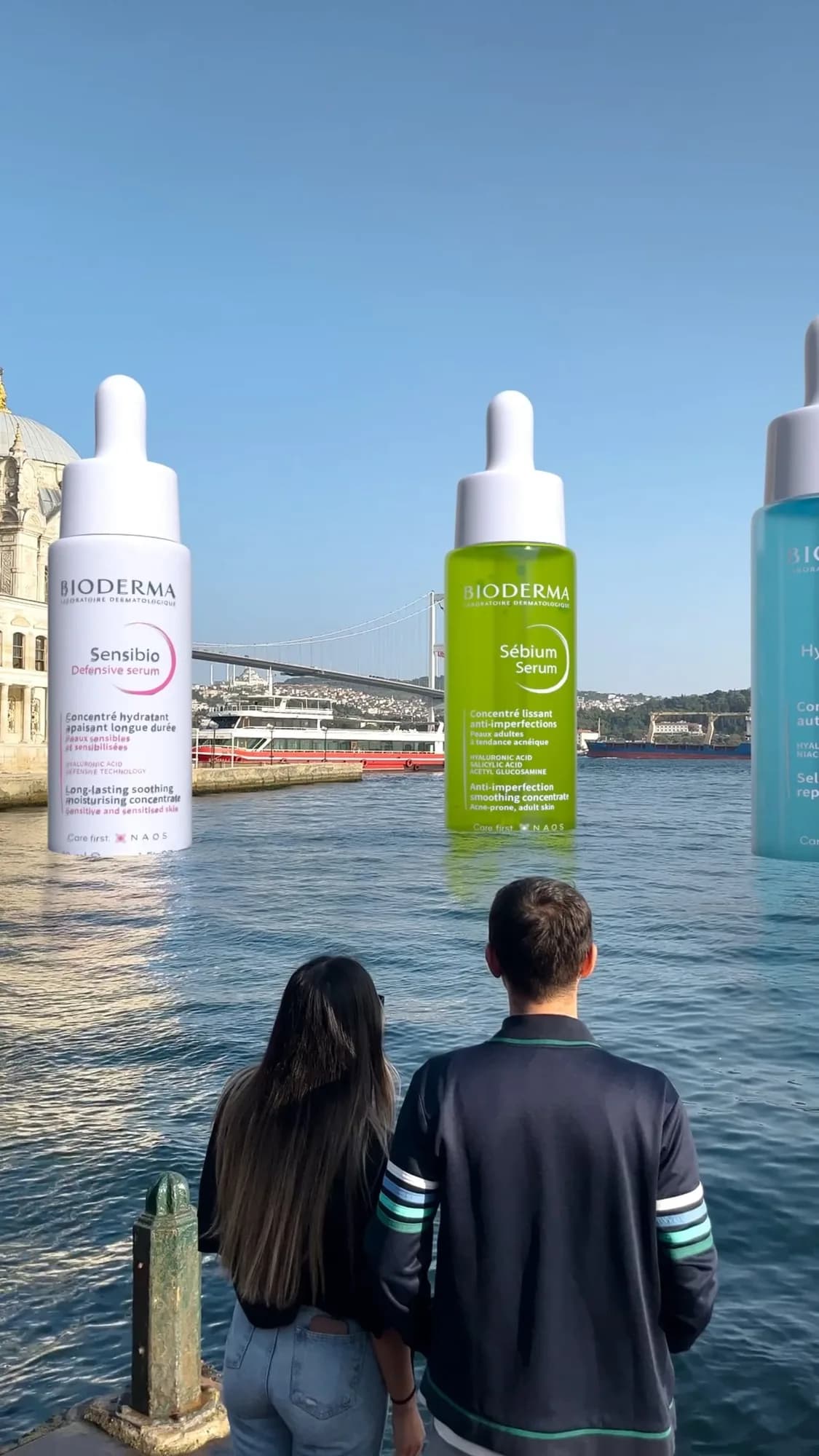
Giant bottles of Bioderma's signature serums rise from the waters of the Bosphorus as people on the shore stop to take in the view. The Bioderma FOOH campaign pairs skincare with Istanbul's skyline and was designed in vertical format to spark curiosity and travel on social.
PROJECT VIDEO
Sephora: black-and-white stripes take over the city
For Sephora's Bodrum launch, the brand's iconic black-and-white stripes settle into the real texture of the city and take the launch straight to the street. Here a beauty retailer makes its identity, rather than a single product, the hero; the Sephora Bodrum launch passed 10M+ views.
PROJECT VIDEO
MAD Parfum: a giant bottle breaks the billboard
A giant perfume bottle smashes through a city billboard and the line between reality and imagination disappears. The MAD Parfum film turns conventional outdoor advertising into a brand moment built to get people talking online.
Estrid: an unexpected illusion on an ordinary billboard
The Estrid billboard film turns an ordinary billboard into an unexpected illusion that puts the brand at the centre of the cityscape. It was designed to make viewers wonder whether it really happened, and edited vertically for social.
What the four have in common is one strong image: a giant bottle, a recognisable stripe pattern, a broken billboard. In beauty, the simpler the idea, the more clearly the product reads. We explain why the opening moment matters so much in the opening seconds of a social ad.
How should you prepare for a beauty CGI project?
A good beauty CGI project starts with a few clear inputs from the people who know the product best: the brand. We suggest including:
- Product photos, plus packaging and label files or a 3D model if you have them
- Colour references and brand guidelines, especially for make-up with a shade range
- The one feature the film should lead with: texture, the feel of the scent, new packaging or a new shade
- Approved product claims and any lines cleared for on-screen use
- Channels and formats: vertical social, product pages, in-store screens
- The launch date and who signs off
For the full template, see how to write an ad film brief. The process itself is simple: idea and sign-off, a shoot if needed, production, edit and delivery.
Frequently asked questions
Does CGI replace a real product shoot in beauty advertising?
Not always. Real footage is strongest for people-led scenes such as models, skin and the moment of use; the product itself, its texture and scenes that play with scale are easier to control in CGI. Most campaigns use both.
Does FOOH work for fragrance advertising?
Yes. Perfume bottles have recognisable silhouettes, which suits FOOH well: a giant bottle in a familiar place reads at a glance. MAD Parfum's billboard breakout is one example.
If the packaging changes, does the film have to be remade?
Usually not. In CGI, a product colour or packaging change is a material update rather than a reshoot, so the same scene can be updated with the new pack.
What should I send for a quote?
A short brief with your goal, channels, product information (photos, or a 3D model if you have one), references and timeline is enough. We reply within 24 hours with an approach.
In beauty, CGI shouldn't make a product look like something it isn't; it should show the real thing in its best light, around an idea people remember. If you'd like to talk through the right approach for your product and launch date, send us your brief, or see how we work in our company deck.