
01ARTICLE
Published on
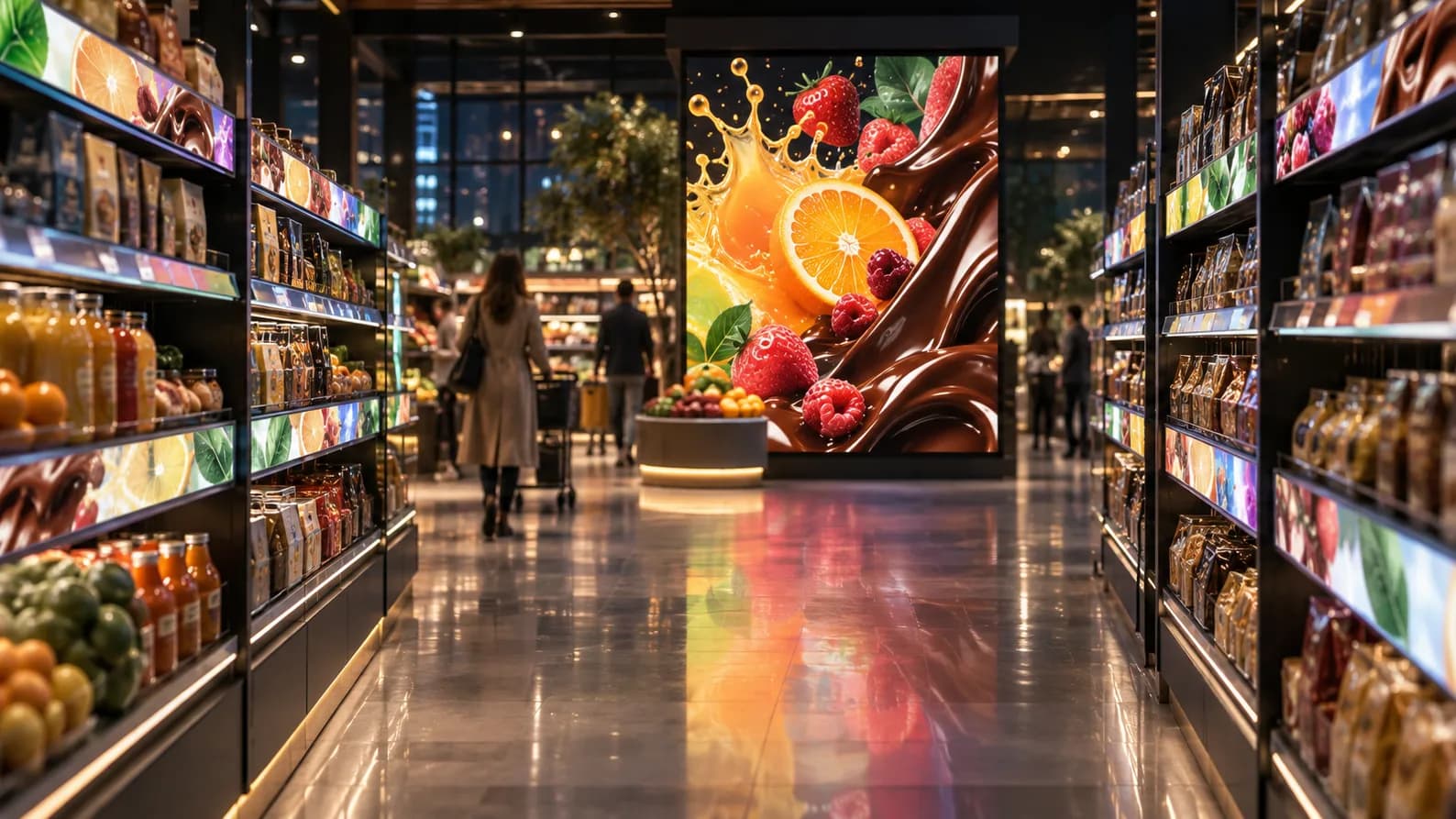
A retail media network is an advertising channel in which a retailer opens its own digital and physical touchpoints to product brands' ads. Producing video content for these networks is different from making a single commercial: you need fast production across many products, multiple formats for different screens, and consistency with the retailer's visual language. This piece covers those needs and a production setup that meets them, using the product films we made for ŞOK as part of ŞOK Media Network.
You can find all of our CGI, FOOH, AI and 3D services on our services page.
What is a retail media network, and why do brands use one?
In a retail media network, the ad space is the set of channels the retailer uses to reach shoppers: its app, its website, in-store screens and similar surfaces. For product brands, the value is being seen close to the moment of purchase; for the retailer, it's a new revenue and content stream from channels it already owns. Three parties are involved: the retailer that runs the network, the product brand that advertises on it, and the studio that produces the content. Each wants something different: the retailer cares about the integrity of its network, the product brand about its product looking right, and the viewer about a short, clear message; the studio's job is to bring those together in one film. In our ŞOK Media Network work, our client is ŞOK, and the films are made for product brands featured on the network.
What do product films on a retail network need?
Product films made for a retail media network have four core needs: speed, scale, multiple formats and consistency. Product accuracy belongs on that list too, because shoppers know the packaging from the shelf.
| Need | Why it matters | What it means in production |
|---|---|---|
| Speed | Product campaigns and shelf periods are short; the film has to be ready on time | A short brief template per product and a clear approval flow |
| Scale | One network carries many products from different categories | A repeatable workflow and several products in production at once |
| Multiple formats | The same film may run in an app, on social media and on screens | Vertical, horizontal and square edits; several length versions |
| Consistency | Viewers see the films as part of the network, not one by one | A shared visual frame: logo area, typography, lighting and edit rhythm |
| Product accuracy | Packaging known from the shelf has to look the same on screen | Working from packaging artwork and current product images, with labels and logos as the final check |
On screen, these needs translate into a few simple things: the product appears in the opening seconds, the packaging is readable, and the message works with the sound off. A short product film has no room for a second idea; its job is to introduce the product and make it stick.
Scale is often met through versions: the same product film can be reused with a different end card for a campaign period, a different length or a different frame. Planning those versions while the main film is being designed saves work later. If several episodes are planned around the same product or campaign, the episode plan in our guide to episodic social media content helps too.
How do you set up production at scale?
The way to deliver many product films at the same quality and on time is to build a repeatable setup instead of treating each film as a blank page:
- A shared visual frame: The retailer's rules (logo placement, typography, colour, opening and closing frames) are defined once, and every new film is produced inside that frame.
- A short brief per product: The product, one key message, the channels and the delivery date. The shorter the template, the faster the turnaround.
- The source of the product image: The brand's product photos and packaging artwork, our own shoot, a 3D model or AI, whichever suits the film.
- A clear approval chain: On retail media work, the retailer and the product brand both look at the same film; writing down who approves what, up front, keeps revision rounds short.
- A consistent delivery package: Formats, lengths and file naming are delivered in the same structure for every film.
- Archive and updates: Project files are kept in order so a film can be updated quickly when the packaging or the campaign changes.
For the wider brief framework, our 10 questions to ask before commissioning an ad film make a useful checklist.
Which method: live action, CGI or AI?
Depending on the project, product films are made with live action, CGI, AI or a mix of them. The product, the look you want and the schedule decide: CGI or a shoot leads where every detail of the product must be exact, and AI leads where you need many variations and fast exploration. Within one network, different films can use different methods; what matters is that the results meet inside the shared visual frame. When choosing a method, the question is simple: which detail must the viewer recognise? The text on the pack, the texture of the product, or the moment of use? The answer points to the method.
Examples from Clytech
Clytech is a CGI, FOOH and AI advertising studio based in Istanbul and London. We've produced many product films for ŞOK as part of ŞOK Media Network; below are three of them, plus a project for the retailer's own brand.
Nivea: Sun. A vertical (9:16) product film developed for Nivea as part of ŞOK Media Network. As with our other work on the network, the client here is ŞOK.
PROJECT VIDEO
Colgate: Product Film. A vertical product film developed for Colgate as part of ŞOK Media Network. When products from different categories share one network, the films need to hold a common quality line.
PROJECT VIDEO
Barilla: Product Film. Another vertical product film, developed for Barilla as part of ŞOK Media Network. Running from personal care to food, these pieces show how different categories sit side by side on one network, and why a shared visual frame matters.
Frequently asked questions
Who is the client on retail media network films?
It depends on how the network is set up. On the films we produce as part of ŞOK Media Network, our client is ŞOK, and the films are made for product brands featured on the network.
How is retail media content different from a traditional commercial?
A traditional commercial usually centres on one strong film. Retail media content is a stream of films for many products, made quickly, in multiple formats and along a shared visual line. The effort shifts from polishing one idea to running a repeatable setup.
Where does the product image come from?
Depending on the project, from the brand's product photos and packaging artwork, our own shoot, a 3D model or AI. In every case, the final check is that the label, logo and shape are true to the real product.
Which formats do you deliver?
Vertical, horizontal and square edits, plus length versions, depending on the channel. The Nivea, Colgate and Barilla films in this piece were produced vertical (9:16).
Can films made for the network run on other channels?
Which film runs on which channels, and for how long, is settled at the quote stage; if it's planned up front, the versions are prepared accordingly.
Next step
If you run a retail media network, or plan regular video content for brands featured on one, let's build a production setup that scales. Send us a short brief covering your channels, your product range and your schedule, and we'll reply within 24 hours. To see more of our work, take a look at our company presentation.